

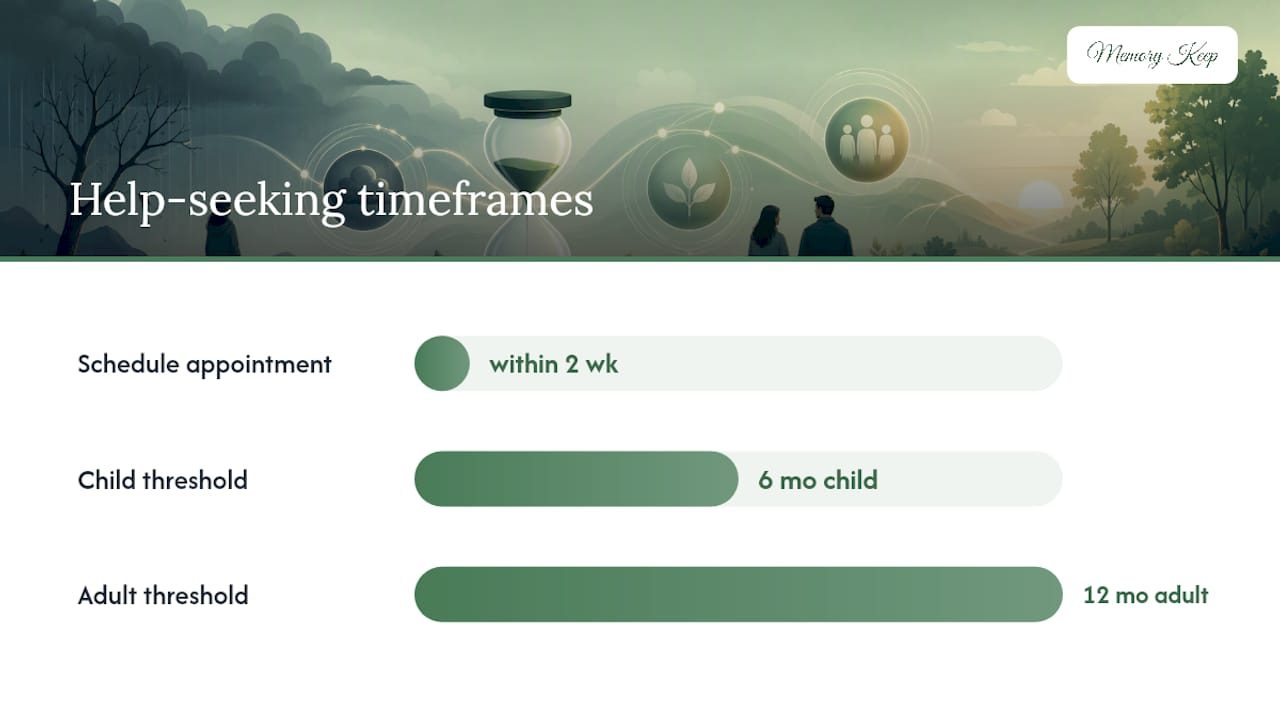
Complicated grief, now formally recognized by the American Psychiatric Association as Prolonged Grief Disorder (PGD), is not simply grief that lingers. It is a clinical condition in which the natural transition from acute mourning to integrated loss fails to happen, leaving you caught in a painful loop of longing, disbelief, and disconnection that disrupts daily life. If you or someone you love is showing the signs of complicated grief listed below, and those signs have persisted for more than 12 months in an adult (or more than 6 months in a child or adolescent), speaking with a mental health professional is the right next step.
Warning signs that may indicate complicated grief:
- Intense, persistent yearning or longing for the person who died
- Preoccupation with thoughts of the deceased or the circumstances of the death
- Disbelief that the loss actually happened, even long after the death
- A shattered sense of identity (“I don’t know who I am without them”)
- Emotional numbness or feeling that life is meaningless
- Avoiding reminders of the person, or conversely, clinging to objects and places connected to them
- Withdrawal from friends, family, and activities you once valued
- Suicidal thoughts, especially thoughts of reunion with the deceased
If you are experiencing suicidal thoughts or have a plan to harm yourself, please call or text 988 (Suicide and Crisis Lifeline) or call 911 now. You do not need to face this alone.
Key Takeaways
Complicated grief, formally called Prolonged Grief Disorder, is a clinically distinct condition requiring grief-specific treatment, not simply more time or a standard antidepressant.
| Point | Details |
|---|---|
| Duration threshold | Symptoms persisting beyond 12 months in adults (6 months in children) may indicate Prolonged Grief Disorder. |
| Core warning signs | Intense yearning, disbelief, identity disruption, avoidance, and suicidal thoughts are the most clinically significant indicators. |
| Screening tools available | The ICG, PG-13, and Brief Grief Questionnaire help clinicians identify who needs grief-focused referral. |
| Seek help immediately | Call 988 or 911 if you have suicidal thoughts or a plan; schedule a clinician visit if symptoms impair daily functioning. |
| Memory Keep’s role | Memory Keep offers a private, collaborative memorial space that can support connection and remembrance alongside, not instead of, clinical care. |
Table of Contents
- Why prolonged grief disorder matters for your health
- What are the signs of complicated grief, symptom by symptom?
- How clinicians diagnose prolonged grief disorder
- How does complicated grief differ from depression and PTSD?
- What increases the risk of complicated grief?
- How complicated grief affects daily life and physical health
- Evidence-based treatments and self-care strategies
- When should you seek professional help?
- How structured memorialization can support healthy grieving
- Recognizing when grief has gone awry, and what to do first
- A gentle place to preserve memories while you heal
- Sources
Why prolonged grief disorder matters for your health
Most people who lose someone they love will grieve deeply, and that grief is normal, healthy, and necessary. Prolonged Grief Disorder, however, affects an estimated 5–7% of bereaved adults, according to clinical reviews published in StatPearls. That may sound like a small number, but given how many people experience significant loss each year in the United States, it represents hundreds of thousands of individuals whose grief has become disabling rather than healing.
The clinical distinction matters because complicated grief and ordinary bereavement require different responses. Normal grief tends to soften over time. Acute sorrow gradually gives way to what clinicians call “integrated grief,” where the loss becomes part of your life story without consuming it. In complicated grief, that transition stalls. The American Psychiatric Association notes that the hallmark separating Prolonged Grief Disorder from healthy bereavement is persistent, disabling impairment in daily functioning, whether at home, at work, or in relationships.
Recognizing complicated grief also matters because its treatment differs meaningfully from treatment for major depression or PTSD, two conditions it is often confused with. Prescribing an antidepressant alone, for example, may ease a co-occurring low mood without touching the core grief symptoms at all.
What are the signs of complicated grief, symptom by symptom?
The APA’s guidance on Prolonged Grief Disorder organizes symptoms around two main clusters: separation distress and cognitive or emotional disruption. Together, these produce the functional impairment that defines the condition.
Separation distress
- Intense yearning: A persistent, aching longing for the person who died. This is not a passing wave of sadness; it is a near-constant pull that can make ordinary moments feel unbearable.
- Preoccupation with the deceased: Intrusive thoughts about the person, replaying memories, or fixating on the circumstances of the death, even when you want to focus on something else.
- Proximity-seeking behaviors: Keeping every item the person touched exactly as it was, visiting places they loved compulsively, or being unable to remove their belongings months or years after the death.
Cognitive and emotional disruption
- Disbelief: A persistent sense that the death did not really happen, or that the person might still return. This goes beyond the early shock of loss and continues well past the first year.
- Identity disruption: Feeling that a core part of yourself died with the person. Many people with complicated grief struggle to imagine a future, make plans, or reconnect with who they were before the loss.
- Emotional numbness: Feeling detached from your own emotions or from the world around you, as though life is happening behind glass.
- Guilt and anger: Guilt that is specifically tied to the death (“I should have called that day,” “I could have done more”) and anger that may be directed at the deceased, at medical providers, or at the circumstances of the death.
- Suicidal ideation: Thoughts of dying, often framed as a desire to be reunited with the deceased rather than a wish to escape life’s pain. This distinction matters clinically, but suicidal thoughts of any kind require immediate attention.
In daily life, these symptoms can look like: missing months of work, withdrawing from children or a partner, skipping meals, abandoning hobbies that once brought joy, or spending hours each day looking at photos or visiting a grave. Mayo Clinic includes intense sorrow, rumination, social withdrawal, and changes in sleep and appetite among the signs clinicians watch for during evaluation.
Pro Tip: Keep a simple two-week symptom log before your first clinician visit. Note which symptoms appear, how long they last, and how much they interfere with your day. This log gives your provider a clearer picture than memory alone and can shorten the time to an accurate diagnosis.

How clinicians diagnose prolonged grief disorder
Diagnosis is not something you can or should do on your own, but understanding the criteria helps you know when to seek care and what to expect when you do.
Timeframe thresholds
The DSM-5 framework, as discussed in the Shear et al. clinical review, sets the minimum duration at 12 months for adults and 6 months for children and adolescents before a diagnosis of Prolonged Grief Disorder can be considered. These thresholds exist because intense grief in the first months after a loss is expected and does not, by itself, indicate a disorder. Cultural and religious practices also shape how grief is expressed and how long mourning rituals last; a skilled clinician will account for those contexts rather than applying a rigid calendar.
Named screening tools
Clinicians use validated instruments to screen for complicated grief, often before or alongside a clinical interview. StatPearls identifies the following as the most commonly used:
| Screening Tool | Developed By | Primary Use |
|---|---|---|
| Inventory of Complicated Grief (ICG) | Holly Prigerson, PhD | Research and clinical settings; self-report |
| Brief Grief Questionnaire (BGQ) | Shear et al. | Ultra-short primary care screen; 5 items |
A positive screen on any of these tools does not confirm a diagnosis. It signals that a full clinical interview is warranted. Primary care physicians increasingly use the Brief Grief Questionnaire as a first-pass tool precisely because it takes only a few minutes and can identify patients who need a referral for grief-focused treatment.
Before your first appointment, consider bringing:
- Your two-week symptom log
- A completed or partially completed BGQ or PG-13 (both are publicly available)
- A list of current medications and any supplements
- The name and contact of a trusted support person who can join you or be available afterward
How does complicated grief differ from depression and PTSD?
This is one of the most clinically important questions in grief care, and the answer has real consequences for treatment. The Shear et al. review found that complicated grief and major depression load on separate factors in factor-analytic studies and respond differently to treatment, which means they are genuinely distinct conditions even when they co-occur.
Complicated grief vs. major depression:
- In complicated grief, sadness and longing are centered on the specific person who died. In major depression, low mood is pervasive and not tied to a single loss.
- People with complicated grief often retain self-esteem and may still feel that the world could be “set right” if only the person could return. People with major depression typically report pervasive worthlessness and hopelessness.
- Guilt in complicated grief is death-specific (“I wasn’t there at the end”). Guilt in depression tends to be global and self-directed.
- Anhedonia, the inability to feel pleasure from anything, is a hallmark of depression. In complicated grief, pleasure is often still accessible in contexts unrelated to the loss.
Complicated grief vs. PTSD:
- PTSD re-experiencing is driven by fear: intrusive memories feel threatening and dangerous. Grief re-experiencing is driven by yearning: intrusive memories feel painful but also precious.
- PTSD avoidance is motivated by fear of the traumatic memory. Grief avoidance is motivated by the pain of confronting the absence.
- Both conditions can follow a traumatic death, and they frequently co-occur. When they do, treatment needs to address both simultaneously.
Comorbidity is common. Many people with Prolonged Grief Disorder also meet criteria for major depression, PTSD, or an anxiety disorder. That overlap changes the treatment plan, which is one more reason an accurate differential diagnosis matters.
What increases the risk of complicated grief?
Complicated grief does not arise from weakness or from loving someone “too much.” It emerges from a combination of factors that shape how the nervous system and psyche respond to loss.
Risk factors with the strongest clinical support:
- Insecure attachment style: People with anxious or dependent attachment patterns are more likely to struggle with the separation that death creates.
- Prior mood or anxiety disorder: A history of depression, generalized anxiety, or PTSD raises the risk considerably.
- Low social support: Isolation after a loss removes the relational scaffolding that normally helps grief move forward.
- Traumatic, violent, or sudden death: Losses that come without warning, or that involve violence, accident, or suicide, carry a higher risk of complicated grief in survivors.
- Caregiving burden: People who provided intensive care to the deceased over a long illness sometimes find that their identity and daily structure collapse entirely when the caregiving role ends.
- Loss of a child or loss of a partner: These losses carry a particularly high risk of prolonged grief, in part because they disrupt core identity and daily life most profoundly.
For families navigating the loss of a parent, our guide to dealing with parental loss offers additional context on why these losses can feel so destabilizing.
Pro Tip: If you recognize two or more of these risk factors in yourself or someone you love, consider reaching out to a grief-informed therapist proactively, even before symptoms reach the 12-month threshold. Early support can sometimes prevent acute grief from becoming prolonged.
How complicated grief affects daily life and physical health
The effects of complicated grief reach well beyond sadness. The APA describes disabling functional impairment as the defining feature of Prolonged Grief Disorder, and that impairment touches nearly every domain of life.
Functional and relational impacts:
- Difficulty concentrating at work, frequent absences, or inability to return to employment
- Withdrawal from friends, family, and social activities
- Impaired parenting, including emotional unavailability to children
- Neglect of basic self-care: nutrition, hygiene, medical appointments
Physical health consequences:
- Chronic sleep disturbance, including insomnia and hypersomnia
- Increased risk of cardiovascular events in older bereaved adults
- Somatic symptoms such as fatigue, headaches, and gastrointestinal distress
- Elevated rates of substance use as a coping mechanism
Suicide risk deserves particular attention. Clinical reviews, including the Shear et al. analysis, link complicated grief to elevated suicidal thinking and behavior. Critically, suicidal ideation in this population often centers on an imagined reunion with the deceased rather than on pervasive hopelessness. This distinction matters when a clinician assesses imminent risk, but it does not make the thoughts less serious. Any suicidal ideation warrants prompt clinical attention.
Evidence-based treatments and self-care strategies
The good news is that Prolonged Grief Disorder responds to treatment. The challenge is finding a provider who uses grief-specific approaches rather than generic depression protocols.
Psychotherapy
StatPearls identifies Complicated Grief Therapy (CGT), developed at Columbia University, as the most evidence-supported treatment for prolonged grief. CGT integrates elements of cognitive-behavioral therapy with grief-specific techniques: revisiting the story of the death, processing avoidance, rebuilding a sense of the future, and restoring connection to others. Grief-focused CBT approaches also show meaningful benefit.
Medication
Antidepressants may help when major depression co-occurs with prolonged grief, but they have limited direct effect on core grief symptoms like yearning and preoccupation. Medication is a support for comorbidities, not a primary treatment for grief itself.
Support options
- Grief-focused support groups (in-person or online)
- Bereavement counseling through hospice organizations
- Peer support programs, including those offered through community mental health centers
- Online grief resources and support hubs that connect you to nonprofits and programs
Practical self-care steps you can start now
- Establish a consistent sleep schedule, even when sleep feels impossible.
- Schedule one brief social contact each day, a text, a call, or a short visit.
- Set aside a specific, time-limited window each day for grief (20–30 minutes), then gently redirect attention afterward.
- Resume one small activity you valued before the loss, even if it feels hollow at first.
- Eat regular meals and limit alcohol, which disrupts sleep and amplifies emotional pain.
Questions to bring to a clinician:
- “Do my symptoms meet criteria for Prolonged Grief Disorder?”
- “Are you trained in Complicated Grief Therapy or grief-focused CBT?”
- “Should I be screened for co-occurring depression or PTSD?”
- “What does a realistic treatment timeline look like?”
When should you seek professional help?
Some moments call for immediate action. Others call for a scheduled appointment. Knowing the difference can feel hard when you are in the middle of grief, so here is a clear framework.
Seek immediate help now if:
- You are having thoughts of suicide or self-harm, with or without a specific plan.
- You are unable to care for yourself or dependents (not eating, not sleeping for days, unable to leave bed).
- You are using substances in ways that feel out of control.
Call 988 or 911 immediately if you have a plan or intent to harm yourself.
Schedule a mental health appointment within the next two weeks if:
- Your grief symptoms have persisted for more than 12 months (or 6 months for a child) and are still interfering with daily life.
- You have withdrawn from most relationships and activities.
- You cannot imagine a future or make basic plans.
- A family member or close friend has expressed concern about your wellbeing.
That last point carries more weight than it might seem. The Columbia University Center for Prolonged Grief notes that family and friends often recognize when grief has gone awry before the mourner does. If someone who loves you has asked whether you are okay, take that seriously.
Pro Tip: Ask a trusted friend or family member to come with you to your first appointment. Their observations about changes in your behavior and mood can give your clinician information you might not think to mention, and their presence can make the visit feel less daunting.
For friends and family wondering how to help, our guide on supporting a grieving friend offers specific, compassionate steps.
How structured memorialization can support healthy grieving
Memorialization, the act of honoring and preserving the memory of someone you have lost, can be a meaningful part of grief when it is used with intention. The key word is intention. There is a difference between creating a space to remember and using keepsakes or rituals to avoid confronting the reality of the loss.
Ways memorialization can support healthy grieving:
- Sharing photos, stories, and tributes with family and friends can reduce isolation and invite the social support that complicated grief often erodes.
- Collaborative memorials, where multiple people contribute memories, can help you see the person through others’ eyes and begin to integrate the loss into a shared narrative.
- Scheduled, time-limited moments of remembrance (lighting a candle on a birthday, visiting a memorial page on an anniversary) give grief a container rather than letting it spill into every hour.
A boundary worth keeping: If you find yourself spending hours each day on a memorial page, unable to stop, or using it to avoid the reality of the death, that is a sign to bring it up with your therapist. Proximity-seeking behaviors can become a form of avoidance, and avoidance is one of the core maintaining factors in Prolonged Grief Disorder.
Pro Tip: Set a gentle time limit when you visit a memorial page or look through photos, perhaps 20 minutes. Afterward, do one thing that connects you to the present: a short walk, a meal with someone, a brief phone call. This rhythm honors the past without letting it crowd out the present.
Memorialization is a supportive, adjunctive practice. It is not a substitute for therapy when symptoms are impairing your ability to function.
Recognizing when grief has gone awry, and what to do first
There is something we want to say plainly, with care: grief that has become complicated is not a failure of love, and it is not a character flaw. It is a condition that happens to people who loved deeply, often in circumstances that made loss harder to bear. The mourner is rarely the first to see it. More often, it is a partner who notices the untouched dinner plate, a sibling who realizes the calls have stopped, a colleague who sees the vacant look that has lasted too long.
If that description sounds familiar, whether you are the one grieving or the one watching, the first practical step is simply to name what you are seeing. Track symptoms for two weeks. Use the Brief Grief Questionnaire or the PG-13 as a starting point. Contact a primary care provider or a mental health professional and bring those notes with you. Involve a trusted person in that first appointment if you can. None of these steps require certainty that something is “wrong enough.” They only require the willingness to find out.
Grief is lighter when it is shared, and help is closer than it often feels.
A gentle place to preserve memories while you heal
When someone you love dies, the need to hold onto them is real and human. Memory Keep was built for exactly that: a private, permanent online memorial where family and friends can gather photos, videos, tributes, and messages of remembrance in one place, accessible anywhere in the world through a unique shareable link.

Memory Keep is not a therapy platform, and it is not a substitute for clinical care when grief has become prolonged. What it offers is something quieter and equally real: a place where the people who loved the same person can come together, contribute their own memories, and feel a little less alone. Features like collaborative uploads, QR codes for headstones or memorial cards, downloadable keepsake photo books, and optional grief support resources make it a thoughtful companion to the healing process. A free plan is available, and a one-time $30 upgrade unlocks unlimited photos, videos, and storage for a single memorial.
When you are ready, create a memorial at Memory Keep and invite the people who share your love to gather there.
Sources
The following sources are clinician-reviewed or peer-reviewed and are appropriate to share with your provider.
- Prolonged Grief Disorder - American Psychiatric Association
- Grief and Prolonged Grief Disorder - StatPearls - NCBI Bookshelf
- Complicated grief - Symptoms and causes - Mayo Clinic
This article provides general information about complicated grief and Prolonged Grief Disorder. It is not a substitute for professional medical or mental health advice. Please consult a qualified clinician to discuss your specific situation and confirm current diagnostic criteria.