
Pick one prompt from below, set a timer for 5 to 15 minutes, and write without stopping to edit. Grief journal prompts work best when matched to how you feel today, not to a rigid schedule. If a prompt feels like too much, stop, breathe, and switch to a gentler one, or reach out to someone you trust.
TL;DR:
- Using specific, guided prompts helps shape grief writing and prevents feeling overwhelmed by open-ended questions, especially in early or intense grief phases.
- Short, sensory-focused entries, such as describing a smell or a memory, are more effective than broad statements and help preserve meaningful moments.
- Structuring writing sessions with a quiet space, a timer, and grounding activities safeguards against emotional overwhelm and encourages safe reflection.
- Techniques like building a memory archive or writing to the person over time can create lasting keepsakes and support long-term remembrance.
- Avoid forcing lengthy or heavy entries; adapt prompts as needed and seek professional help if grief-related thoughts become unmanageable or cause self-harm.
Table of Contents
- Why Grief Journal Prompts Actually Help
- How to Use Grief Prompts Safely
- Prompts for Fresh, Early Grief
- Prompts for Remembering and Preserving Memories
- Prompts for Ongoing and Long-Term Grief
- Prompts for Anniversaries and Sudden Triggers
- Prompts for Complicated Grief: Guilt, Anger, and Unfinished Business
- Five Practices Worth Trying Beyond Single Prompts
- Memory Keep Resources for Grieving Writers
- A Note From Memory Keep on Writing Through Loss
- Sources
- FAQ
Why Grief Journal Prompts Actually Help
Grief writing is not about producing something polished. It is about giving your mind a place to put what feels too big to carry silently. A peer-reviewed study on directed writing found that prompts focused on meaning reconstruction, rather than open-ended freeform writing, led to greater improvement in prolonged grief, depression, and PTSD symptoms, along with measurable gains in physical health.
That distinction matters for how you choose your prompts. A blank page that simply says “write about your loss” can feel paralyzing. A prompt that asks something specific, like naming a memory or describing a feeling, gives your grief a shape to move through.
Journaling after loss is not about writing well. It is about writing honestly, even if that means a single sentence or a page of scattered thoughts.
Journaling for grief also builds something tangible: a record of memories, feelings, and moments that might otherwise slip away. You don’t need a special notebook or a writing background. Harvard Health notes that short sessions, even just a few minutes, can ease the weight of grief, and there’s no required format or supply list to get started.
How to Use Grief Prompts Safely
Grief journal prompts work best inside a little structure. That structure protects you from spiraling into an entry that leaves you more raw than when you started.
- Pick your space. Find somewhere quiet where you won’t be interrupted, even if that’s just five minutes on a porch step.
- Set a timer. A short duration such as several minutes is plenty. Longer isn’t better here.
- Write freely. Don’t edit, don’t judge your grammar, don’t worry about whether it makes sense to anyone else.
- Choose by feeling, not by date. If today feels heavy, pick a fresh-grief prompt even if your loss happened years ago. Grief doesn’t follow a calendar.
- Notice your body. If you feel your chest tighten or your breathing quicken, pause. That’s your cue to stop or switch prompts.
- Close with something grounding. A few slow breaths, a glass of water, or stepping outside can help you land after a heavy entry.
Pro Tip: Keep a second, gentler prompt bookmarked for hard days. If the first prompt opens something too raw, you can pivot instead of pushing through.
If writing consistently leaves you unable to function, or if you’re having thoughts of self-harm, that’s beyond what journaling alone can hold. SAMHSA’s Find Help resource connects you with crisis support and referrals when you need more than a page and a pen.
Prompts for Fresh, Early Grief
The first days and weeks after a loss are disorienting. Your mind might replay moments on a loop, or feel strangely blank. These grief writing prompts are meant to be small and specific, not sweeping.
- Today I feel…
- The hardest moment today was…
- One memory I don’t want to lose is…
- Something someone said that helped (or didn’t) was…
- Right now, my body feels…
- A smell, sound, or object that reminded me of them today was…
- What I wish I could tell them right now is…
- Something small that got me through today was…
- A question I keep asking myself is…
- One thing I’m grateful I got to experience with them is…
Lean into sensory detail. Instead of writing “I miss them,” try describing the specific sound of their laugh or the way they held a coffee mug. Single, concrete memories tend to hold more weight than broad statements, and they’re easier to return to later.
One caution: don’t reread heavy entries right after writing them. Close the notebook, get up, and give yourself distance. You can revisit the words when you’re steadier, if you choose to at all.
Prompts for Remembering and Preserving Memories
Once the sharpest edge of early grief softens slightly, many people find comfort in prompts that build a memory archive. These grief reflection prompts shift focus from processing pain to preserving a person or pet as they actually were.
- Describe their hands. What did they look like, and what did they do with them?
- What was their signature phrase, the thing they said so often you can still hear it?
- Tell a story only you would know, one nobody else witnessed quite the way you did.
- What made them laugh, and what did that laugh sound like?
- Describe a room, a car, or a space that felt distinctly theirs.
- What’s a habit or quirk of theirs you find yourself missing most?
Each entry adds to a growing, searchable collection of specific memories. Over time, that archive becomes something you can draw from for a keepsake photo book, a toast, or a memorial page. If you’re preserving these stories for family, consider what you’re comfortable sharing versus what stays private. Not every memory needs an audience, and it’s fine to draw that line for yourself.
Prompts for Ongoing and Long-Term Grief
Grief doesn’t end on a timeline. Months or years later, it often resurfaces in quieter, more integrated ways, and your journal prompts for grief can shift with that change.
- What have I learned about myself through this loss?
- What part of them do I still carry with me, in how I act or think?
- How has my relationship with grief changed since the first year?
- What would I want to tell someone just beginning this loss?
- What have I built or grown into since they died?
- Where do I still feel their absence most sharply, and where has it softened?
Revisit these prompts every few months rather than daily. The point isn’t tracking progress like a checklist. It’s noticing how grief has settled into your life differently over time. This isn’t about “moving on,” a phrase that implies leaving someone behind. It’s about integration, carrying them forward as part of who you are now.
Prompts for Anniversaries and Sudden Triggers
Certain dates, or certain unexpected moments, can knock the wind out of you even years later. A birthday, a holiday, a song on the radio. Having prompts ready ahead of time gives you somewhere to land.
- What memory is loudest today?
- What ritual feels right today, a candle, a photo, a favorite meal?
- What do I want this day to look like next year?
- What am I avoiding thinking about right now, and why?
Pairing a prompt with a small ritual, lighting a candle, taking a short walk, or visiting a place that mattered to them, gives the day structure. If you know a hard date is coming, plan something gentle in advance rather than hoping you’ll be fine. A death anniversary ritual can offer more ideas for marking these dates with intention. Build in a self-care buffer afterward: rest, a call to a friend, or simply permission to do nothing.
Prompts for Complicated Grief: Guilt, Anger, and Unfinished Business
Some losses carry weight beyond sadness: guilt over things said or unsaid, anger at how someone died, or conversations that never got finished. These prompts give that complexity somewhere honest to go.
- Write an unsent letter to them, saying what you never got to say.
- What do I feel guilty about, and is that guilt fair to myself?
- What am I angry about, and who or what is that anger really aimed at?
- What conversation do I wish we’d had before they died?
Keep these sessions short, no more than 10 to 15 minutes, and follow with grounding: a few deep breaths, a hand on your chest, a step outside. Harvard Health advises that if a prompt overwhelms you, it’s fine to stop, tear up the page, or bring it into a therapy session instead of finishing alone. Complicated grief, especially when guilt or anger feels stuck, often benefits from pairing these prompts with a therapist or counselor. A look at how counseling supports mental health explains what that kind of professional support can offer alongside your own writing.
Five Practices Worth Trying Beyond Single Prompts
Some grief writing practices go deeper than a single prompt and reward repeated use.
- Letter practice. Write to the person or pet you lost as often as you need. Some people write monthly; others only on hard days.
- Memory archive. Keep a running set of entries that each start with “I remember…”, building a collection you can return to for keepsakes or a memorial page.
- “What I carry” list. Name the traits, habits, or values of theirs you’ve absorbed into your own life.
- Future-self letter. Write to yourself a year from now, describing what you hope has softened and what you hope you’ll still remember clearly.
- Fear inventory. List what scares you most about grieving, whether that’s forgetting details or feeling okay again, and sit with those fears on the page.
Use a single prompt on days you need something small and contained. Reach for a full practice, like the memory archive, when you have more time and want to build something lasting.
Pro Tip: If you want to keep certain entries safe and organized rather than scattered across notebooks, a private Memory Keep memorial page lets you preserve written memories alongside photos and videos, with control over who can see them.
Memory Keep Resources for Grieving Writers
Memory Keep builds tools for preserving memory, and that mission extends naturally into supporting people who write through loss. A few resources worth exploring:
- Twelve Essential Grief Insights covers common grief patterns and what’s normal to feel.
- Grief Resources Online rounds up support options beyond journaling.
- The Help center walks through creating and managing a memorial page.
- Grief & Bereavement Resources covers counseling and community support alongside memorial tools.
If you’d like a place to keep the memories your journal helps surface, whether from writing about a parent, a pet, or anyone else, Memory Keep offers a free plan to start, with a one-time $30 upgrade per memorial for unlimited photos, videos, and features. No subscriptions, no ongoing fees, just a permanent page you control.
A Note From Memory Keep on Writing Through Loss
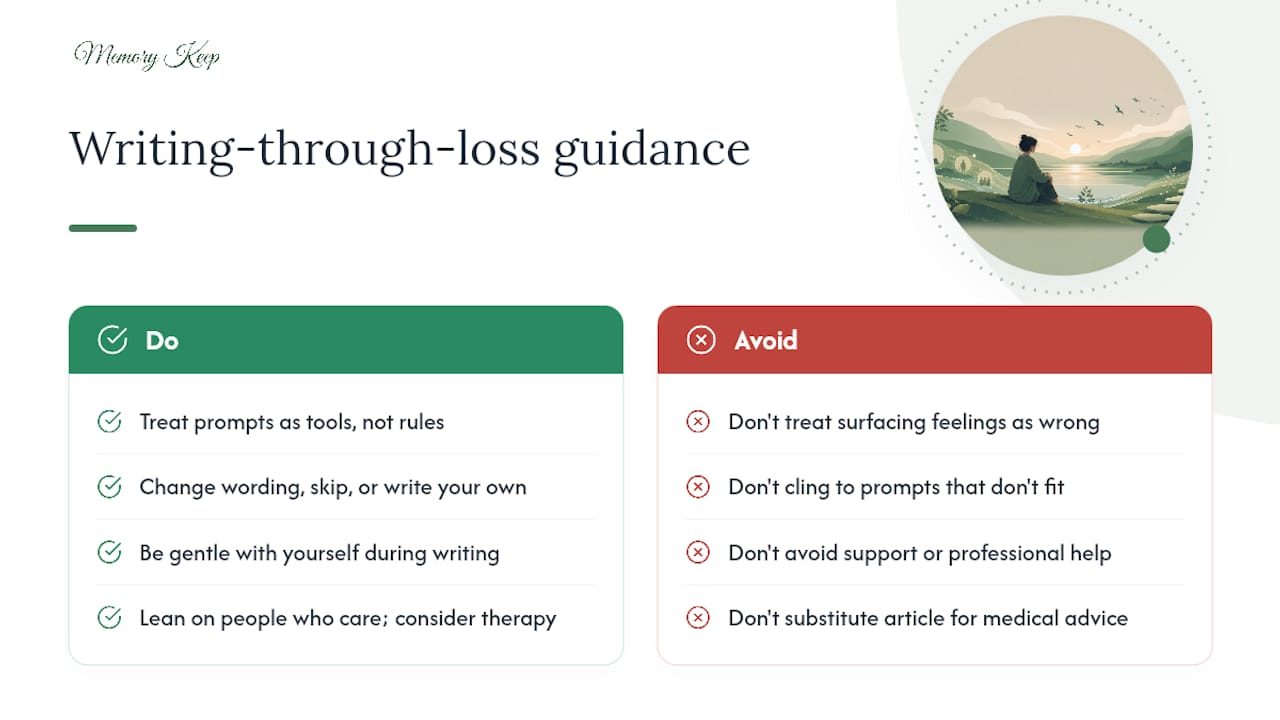
Prompts are tools, not rules. If a question on this page doesn’t fit how you’re grieving, change the wording, skip it, or write your own. Grief looks different in every person, and the prompt that unlocks something for one reader might feel completely wrong for another.
What we’d ask is that you stay gentle with yourself in the process. Writing through loss can surface things you didn’t expect, and that’s not a sign you’re doing it wrong. Lean on people who care about you, and don’t hesitate to bring a therapist into the harder entries. If something you write feels worth keeping, whether it’s a memory, a letter, or a list of what you carry, consider using an online memorial platform where those words can live alongside photos and the people who loved them too.
— Memory Keep
This article is general information, not a substitute for advice from a qualified doctor. Consult a qualified healthcare professional about your own circumstances before acting on anything here.
Sources
- Directed writing study (expressive writing / grief) — PubMed
- Writing to ease grief — Harvard Health Publishing
- Find Help — SAMHSA
FAQ
What Are the Three C’s of Grief?
The three C’s often cited in grief education are choice, connection, and coping, a framework suggesting that grievers benefit from feeling agency in how they mourn, staying connected to others, and building healthy coping tools like journaling. Definitions vary across sources, so treat this as a general guide rather than a fixed clinical standard.
What Is the 3-2-1 Method of Journaling?
The 3-2-1 method typically asks you to write three things you’re grateful for, two things that challenged you, and one thing you learned that day. Applied to grief, it can help you notice small moments of stability alongside the harder parts of a day without ignoring either.
What Organ Does Grief Weaken?
Grief is most often linked to strain on the heart, with research showing a real increase in cardiac stress and even risk of heart-related events in the period after a major loss. Harvard Health’s writing on grief notes that expressive writing can support both emotional and physical well-being during this vulnerable window.
What Is the 3-3-3 Journal Method?
The 3-3-3 method generally asks you to write for three minutes about three specific things, often used as a low-pressure way to start journaling without feeling locked into a long session. For grief writing specifically, this pairs well with short, timeboxed prompts rather than open-ended freeform entries.
Do I Need a Special Journal or App to Start?
No. Harvard Health confirms there’s no required format, supply list, or time commitment for grief writing to help. A notebook, a notes app, or even loose paper works fine; what matters more is choosing a prompt that matches how you feel right now.