

What grief resources online are available to you right now
Grief arrives without warning, and finding your footing afterward takes time, patience, and the right kind of support. The good news is that meaningful help is closer than ever. Online grief support in 2026 spans four broad categories, each serving a different need:
-
Peer-led support groups: Free or low-cost virtual gatherings where people share their experiences and offer one another compassion without clinical pressure
-
Professional online grief counseling: Licensed therapists and counselors offering one-on-one sessions via video or phone, typically billed through insurance or a session fee
-
Educational websites and materials: Articles, videos, fact sheets, and guides from organizations like SAMHSA that help you understand what you are going through
-
Online memorial platforms: Tools like Memory Keep that let families create lasting digital tributes for people and pets they have loved
Many peer-led groups and educational sites are completely free. Professional counseling involves therapy fees, though insurance often helps. Whatever your circumstances, there is a starting point that fits.
Table of Contents
-
How peer groups, counseling, and online communities each support grief differently
-
Educational materials that help you understand your own grief
-
How to support a grieving friend or family member using online resources
-
What to know about privacy and data security on grief platforms
-
Grief support online deserves more honesty than it usually gets
How peer groups, counseling, and online communities each support grief differently
Not all grief support works the same way, and that is actually a gift. You get to choose what fits where you are right now.
Peer-led grief groups offer community validation rooted in shared experience. No clinical credentials are required to participate, and the comfort of sitting with others who truly understand can be profound. These groups differ meaningfully from professional counseling, which provides individualized clinical care tailored to your specific history and needs.
Specialized online communities go one step further by connecting people at the same stage of grief, making conversations feel more relevant and less isolating. GriefShare, for example, runs structured 13-week cycles with expert-led videos followed by peer discussion, costing between $0 and $25 for participant materials. Some platforms offer several free peer sessions monthly with no credit card required.
| Format | Led by | Cost range | Best for |
|---|---|---|---|
| Peer support groups | Fellow grievers | Free to $25 | Community connection, shared experience |
| Professional counseling | Licensed therapist | Insurance or session fee | Individualized clinical care |
| Specialized communities | Peers, stage-matched | Free | Targeted loss types, specific grief stages |
| Structured programs | Experts and peers | $0–$25 | Guided, week-by-week grief work |
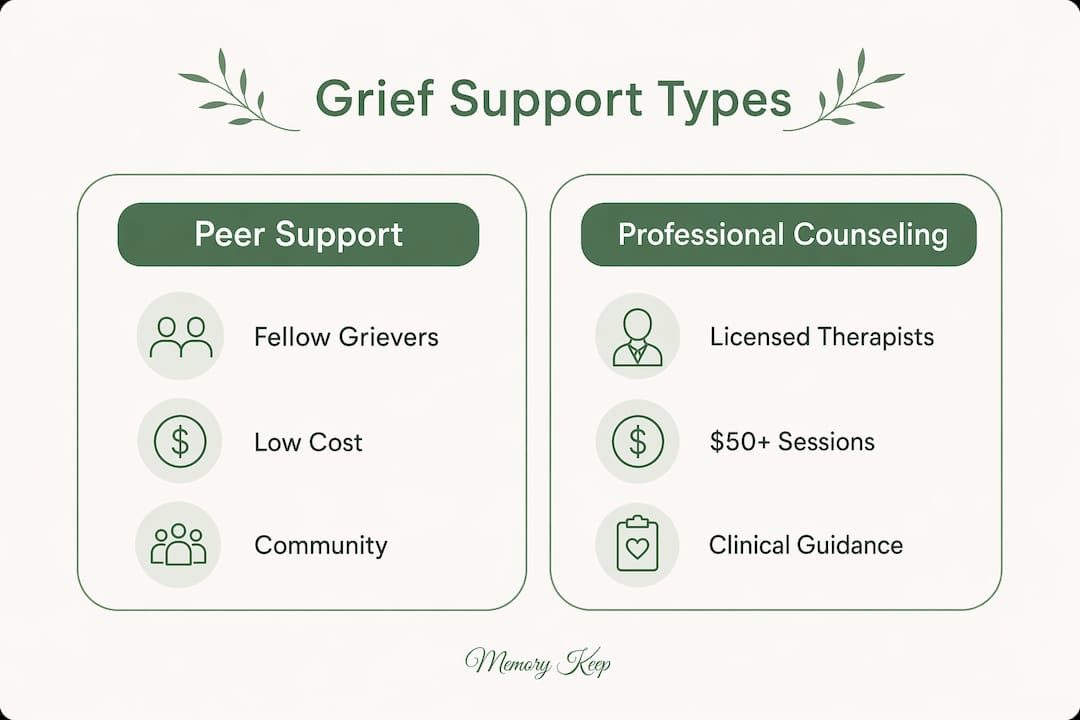
One thing worth knowing: peer support is not a substitute for professional mental health care. For complex grief or acute distress, a licensed counselor is the right call. Many people find that combining both approaches gives them the widest net of support.
Educational materials that help you understand your own grief
Understanding grief does not speed up healing, but it does make the experience feel less frightening. When you can name what you are feeling, the weight of it shifts a little.
SAMHSA offers population-specific grief resources including educational articles, videos, and fact sheets tailored for grieving children, adults, and older adults. The National Institute on Aging provides clear, compassionate guidance on coping with loss, including how to find grief counseling and support groups. Grief.com hosts books, articles, and videos designed to help people navigate the healing process at their own pace.
-
Loss of a parent: Memory Keep’s resource on dealing with the loss of a parent offers specific guidance for one of life’s most disorienting losses
-
Pet loss: Grief over a beloved animal is real and deserves real support; dedicated articles on coping with the loss of a pet acknowledge that fully
-
Supporting children: Resources on helping children through grief give parents and caregivers practical, age-appropriate tools
One insight worth holding onto: there is no single correct way to heal. Grief is not linear, and good educational resources reflect that truth rather than pushing you toward a timeline that does not fit your life.
Creating an online memorial to honor someone you love
A memorial is not just a record. It is a place to return to, a space where love does not have to be past tense.

Digital memorial platforms like Memory Keep give families the tools to build something lasting. A Memory Keep memorial page can hold unlimited photos, videos, and audio recordings, along with written tributes and visitor messages from family and friends anywhere in the world. Each memorial has a unique shareable link, and QR codes can be printed on headstones, cards, or keepsakes so anyone can visit the memorial with a simple scan. Families can collaborate by uploading their own photos and memories, and downloadable photo books or slideshow videos let you hold the tribute in your hands as well as on a screen.
The free plan offers limited uploads and features. A one-time upgrade of $15 unlocks unlimited storage and the full feature set, with no recurring subscription.
-
Photos and videos: Preserve the moments that defined a life
-
Tributes and visitor messages: Let friends and family leave words of love and remembrance
-
Interactive life maps: Mark the places that mattered most
-
QR codes: Connect a physical memorial to a living digital one
-
Collaborative uploads: Invite others to add their own memories
Pro Tip: When you first create a memorial, send the unique link to close family members and invite them to add their own photos and stories. The memorial grows richer with every contribution, and the act of sharing memories together can itself be a meaningful part of grieving.
You can explore the benefits of creating an online memorial and see how families are using these spaces to keep connection alive long after loss.
How to support a grieving friend or family member using online resources
Supporting someone through grief is one of the most tender things we can do for each other. It does not require perfect words. It requires presence.
Guiding a loved one toward peer support groups or educational materials is a gentle, practical way to help without overstepping. Sharing a link to a virtual grief group, or sitting with them while they explore a resource, says “you are not alone in this” more clearly than almost anything else.
-
Share the memorial: Invite friends and extended family to visit and contribute to an online memorial; collective remembrance lightens the weight for everyone
-
Choose words with care: Memory Keep’s guide on what to say when someone dies offers honest, compassionate language for moments that feel impossible
-
Respect their pace: Grief does not follow a schedule; avoid suggesting someone should be “moving on”
-
Care for yourself too: Supporting a grieving person is emotionally demanding; give yourself permission to seek your own support, whether through a peer group or a quiet conversation with someone you trust
Planning ahead for how a family will preserve memories together can also ease the burden in acute grief. Thoughtful end-of-life memory keepsakes give families a tangible way to honor a life while creating something to return to.
What to know about privacy and data security on grief platforms
When you share something as personal as grief, you deserve to know your information is protected.
Before using any online grief platform, check whether it publishes a clear privacy policy explaining how your data is stored, who can access it, and whether it is ever shared with third parties. Reputable platforms will state this plainly. For memorial sites specifically, look for controls over who can view or contribute to a memorial, whether content can be made private or password-protected, and what happens to your data if the platform closes.
Peer support communities that allow anonymous participation, like those that do not require a real name, offer an added layer of comfort for people who are not ready to share publicly. When using professional online counseling, confirm that sessions are conducted over encrypted, HIPAA-compliant video platforms. A little due diligence at the start protects both your privacy and your peace of mind.
Key Takeaways
Online grief support works best when you combine peer connection, professional guidance, and meaningful memorial tools rather than relying on any single resource.
| Point | Details |
|---|---|
| Multiple resource types exist | Peer groups, counseling, educational sites, and memorial platforms each serve different needs. |
| Cost varies widely | Peer-led groups are often free; structured programs like GriefShare cost $0–$25; professional counseling involves therapy fees. |
| Memorials preserve connection | Platforms like Memory Keep let families collaborate on lasting digital tributes with photos, videos, and visitor messages. |
| Privacy matters | Always review a platform’s privacy policy and look for encryption and access controls before sharing personal information. |
| Grief has no timeline | Educational resources and peer communities work best when they honor each person’s unique pace of healing. |
Grief support online deserves more honesty than it usually gets
Most conversations about online grief resources focus on accessibility and variety, which matters. But what gets said less often is this: the format of support is far less important than whether it makes you feel genuinely seen.
A peer group that meets you exactly where you are, without pressure to perform recovery, can do more good than a polished platform with every feature imaginable. An online memorial that your family actually visits and contributes to will outlast one that was built and forgotten. The tools are only as meaningful as the intention behind them.
We also tend to underestimate how much the act of memorialization itself is a form of grief work. Creating a tribute, choosing the photographs, writing the words, inviting others to add their own memories: these are not decorative gestures. They are ways of processing love that has nowhere left to go. That is why platforms built with genuine care for the grieving experience, rather than just the technical features, make a real difference.
Online support is a beginning, not a ceiling. When grief feels complex or overwhelming, please reach out to a licensed mental health professional. The grief and bereavement resources at Memory Keep can help you find your footing, and from there, you can build the kind of support that truly holds you.