

This article gives you copy-ready obituary examples for short newspaper notices, traditional formats, life stories, celebrations of life, and veteran tributes, plus fill-in templates and a step-by-step checklist. Most full obituaries run 200 to 500 words, with short print notices closer to 50 to 150 words, and Memory Keep offers a place to keep the fuller story once the newspaper version is trimmed down.
TL;DR:
- Short obituaries should include a full name, age, city, date of death, survivor list, and clear service details to ensure clarity and completeness.
- Longer obituaries can tell a full story using different styles, such as traditional, narrative, anecdotal, celebration-of-life, or veteran formats, depending on personal preference.
- Draft the full obituary first to include detailed biographical and anecdotal information, then trim it to meet publication limits while verifying all facts.
- Use inclusive language for complex family structures, avoid sensitive or unconfirmed details, and adapt the tone to reflect the deceased’s personality and cultural traditions.
- Digital memorial pages support photos, videos, guestbooks, and links, allowing the full story to extend beyond the printed obituary and reach wider audiences.
Table of Contents
- Copy-Ready Short Obituary Examples
- Longer Obituary Examples by Writing Style
- Fill-In Templates You Can Use Right Now
- How to Write an Obituary Step by Step
- Choosing the Right Tone and Wording
- Publishing: Print, Online, and Word Counts
- Extending an Obituary Into a Full Online Memorial
- Legal and Privacy Considerations
- Cultural and Religious Variations in Obituary Style
- Common Mistakes to Avoid
- [Handling Sensitive Information With Care can be guided by resources like the palliative care compassionate storytelling guide for healthcare organisations to ensure narratives remain respectful and sensitive.](#handling-sensitive-information-with-care-can-be-guided-by-resources-like-the-palliative-care-compassionate-storytelling-guide-for-healthcare-organisationshttpstruecaremediacomaupalliative-care-compassionate-storytelling-guide-to-ensure-narratives-remain-respectful-and-sensitive)
- Adding Photos, Video, and Links to an Online Obituary
- Why Examples Matter More Than Rules
- Keep the Full Story Going Beyond the Obituary
- Sources
Copy-Ready Short Obituary Examples
A short obituary earns its space by getting to the point without feeling cold. Newspapers charge by the line or the word, so these samples stay lean while still carrying warmth. Adjust names, dates, and details, then read the result out loud. If it sounds like something a family member would actually say, it’s ready.
Peaceful passing, older adult: Margaret “Peggy” Sullivan, 84, of Portland, Oregon, passed away peacefully at home on March 3, 2026. She loved her garden, her book club, and Sunday calls with her grandchildren. Peggy is survived by her husband of 58 years, Robert; her children, Anne and David; four grandchildren; and one great-grandchild. A memorial service will be held at 11:00 a.m. on March 10 at Grace Lutheran Church. In lieu of flowers, donations may be made to the Portland Public Library.
Sudden or unexpected death: James “Jim” Ortega, 52, of Tucson, Arizona, died unexpectedly on February 14, 2026. Jim coached Little League for twelve seasons and never missed a chance to fix a neighbor’s fence. He is survived by his wife, Elena; sons Marcus and Diego; his mother, Carmen; and his brother, Luis. A celebration of his life will be announced at a later date.
Brief celebration-style notice: Dorothy Kim, 91, of Baltimore, Maryland, left this world on January 20, 2026, the way she lived: on her own terms, with a cup of coffee nearby. She is survived by three children, seven grandchildren, and a small army of friends who called her “Mama Dot.” Family and friends are invited to share stories and pie at a gathering on January 27 at the community center.
Concise formal notice: Harold T. Weiss, 77, of Cleveland, Ohio, entered eternal rest on April 2, 2026. He was preceded in death by his wife, Ruth. Harold is survived by his daughter, Susan Weiss Carter, and two grandsons. Visitation will be held April 6 from 4:00 to 7:00 p.m. at Riverside Funeral Home, with burial to follow at Woodland Cemetery.
Pet memorial notice: Biscuit, a golden retriever who spent fourteen years greeting every visitor like a long lost friend, passed away on May 9, 2026, at home with his family. He is survived by the Nguyen family, who will miss his spot at the foot of the bed and his talent for finding lost socks.
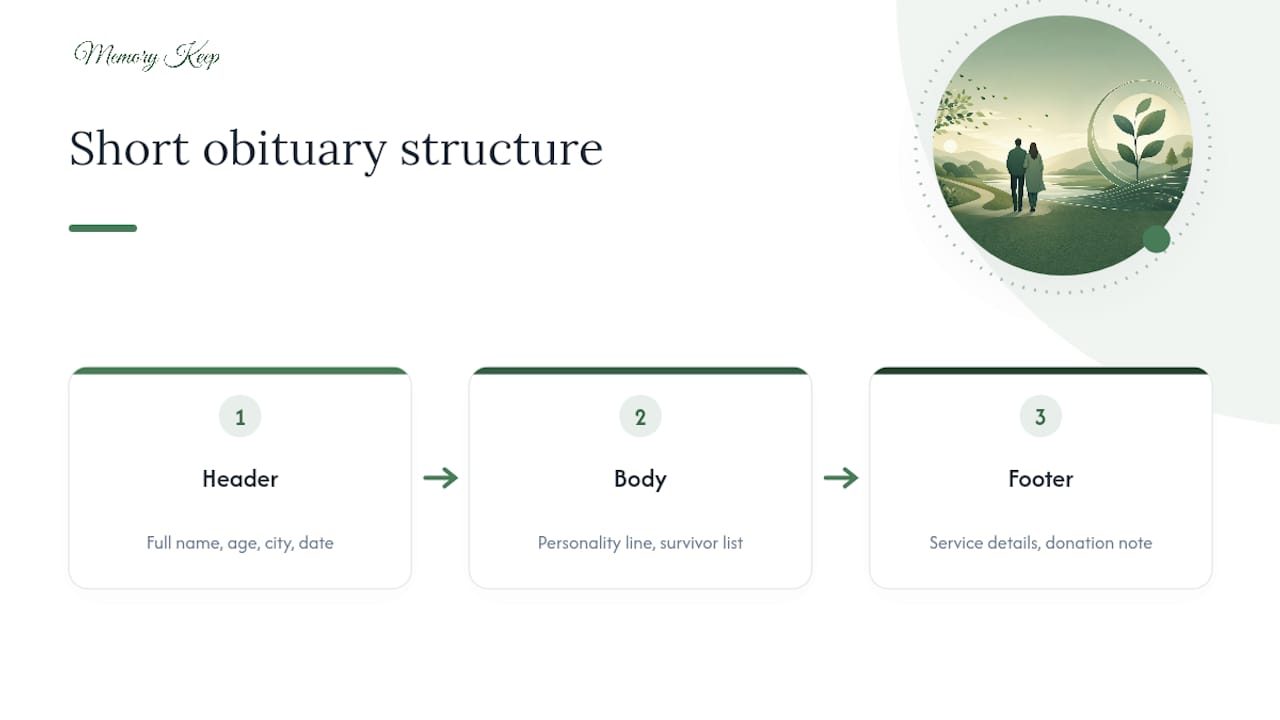
A few things every short sample above has in common: full name, age, city of residence, date of death, one line that shows personality, a clear survivor list, and service details when there are any. Skip the temptation to cram in a full biography here. That’s what the longer formats below are for.
Longer Obituary Examples by Writing Style
Once you move past the newspaper notice, you get room to actually tell someone’s story. The right style depends on who the person was and how the family wants them remembered. Below are five full-length examples, each built around a different structure recommended by obituary guides and each suited to a different kind of life.
-
Traditional obituary. This format follows the classic order: announcement, brief biography, survivor list, service details. It fits families who want a formal, complete record without much narrative flourish.
Example: “Charles Robert Denning, 79, of Richmond, Virginia, passed away on March 12, 2026, surrounded by family. Born on July 4, 1946, in Richmond, Charles was the son of the late William and Eleanor Denning. He graduated from Virginia Tech in 1968 with a degree in civil engineering and spent 35 years designing bridges for the state highway department. Charles married the love of his life, Patricia Ann Combs, in 1970, and the two built a home filled with laughter, model trains, and Sunday roast dinners. He is survived by his wife, Patricia; his children, Michael Denning and Karen Denning Holt; five grandchildren; and his sister, Ruth Denning Baxter. He was preceded in death by his parents and his brother, Thomas. A funeral service will be held at 2:00 p.m. on March 18 at First Presbyterian Church, with interment to follow at Hollywood Cemetery. The family requests memorial donations to the Virginia Tech Engineering Scholarship Fund.” This structure works because every reader, regardless of how well they knew Charles, comes away with a clear picture of his life’s shape. Trim it for print by cutting the education and career sentence to a single clause.
-
Life-story obituary. This narrative style reads more like a short essay than a form. It suits people whose lives had a clear arc or theme worth following. Rather than listing achievements, it follows one thread through the whole piece.
Example: “Maria Elena Torres never planned to become the unofficial mayor of her block on Sycamore Street, but by the time she passed away on April 5, 2026, at age 88, there wasn’t a neighbor within six houses who hadn’t eaten at her table at least once. She arrived in Chicago from Guadalajara in 1961 with $40 and a sewing machine, and within a decade had built a small tailoring business out of her living room. Maria raised four children largely on her own after her husband’s early death, and she never once let anyone in the neighborhood go hungry, whether they asked or not. She is survived by her children, Rosa, Antonio, Guadalupe, and Fernando; eleven grandchildren; and the entire Sycamore Street block, who will hold a gathering in her honor on April 12.” A single defining anecdote like the sewing machine and the $40 carries more emotional weight than a list of dates ever could.
-
Anecdotal obituary. This style centers on one or two specific stories rather than a chronological account. It works well when a family has a favorite memory that captures exactly who someone was.
Example: “Everyone who knew Frank Boyle has a version of the fishing story. Frank, who died peacefully on February 28, 2026, at 71, once spent six hours convinced he’d hooked the biggest catfish in Lake Erie, only to reel in his own boot. He told that story at every family gathering for forty years, and it got a little bigger every time. Frank is survived by his wife, Diane, and their three sons, who have all, at some point, been forced to hear the boot story twice in one sitting.” Keep anecdotal versions to one or two stories maximum. More than that and the piece loses its focus.
-
Celebration-of-life obituary. This tone skips the somber register in favor of warmth and even humor, and it usually points readers toward a gathering rather than a formal service.
Example: “Barbara ‘Bunny’ Callahan, 68, danced her way out of this world on May 1, 2026, probably mid-sentence about something she found hilarious. Bunny taught aerobics for 30 years, ran three marathons after age 50, and never met a karaoke machine she didn’t love. She’s survived by her husband, Pete; her daughters, Jenny and Claire; and a neighborhood full of people who are going to have a much quieter block now. Come celebrate Bunny on May 8 at the VFW hall. Wear something colorful. She’d hate anything black.”
-
Veteran obituary. Military service deserves its own dedicated sentence, placed right after the biographical highlights and before service details, naming the branch, rank, and years served.
Example: “Sergeant First Class Daniel P. Reyes, 64, of San Antonio, Texas, passed away on March 20, 2026. Daniel served in the U.S. Army for 22 years, including two deployments to Iraq, and earned the Bronze Star for valor. After retiring in 2004, he spent the next two decades mentoring young veterans through the local VFW chapter. Daniel is survived by his wife, Consuela; his son, Marcus; and two grandchildren. Full military honors will be rendered at his graveside service on March 26 at Fort Sam Houston National Cemetery.”
Pro Tip: Read your draft aloud to one person who knew the deceased well but wasn’t involved in writing it. If a detail makes them nod or smile, keep it. If it makes them pause and ask “wait, is that right?” cut it or verify it before publishing.
Fill-In Templates You Can Use Right Now
Templates work best when they give you structure without boxing you in. Use the bracketed short version for newspapers and the long version when you’re building out a memorial page.
Short template (50 to 150 words):
“[Full name], [age], of [city, state], passed away on [date]. [He/She/They] was born on [birth date] in [birthplace] and [one line about a defining trait, hobby, or role]. [Name] is survived by [spouse], [children], [grandchildren], and [other relatives]. [He/She/They] was preceded in death by [names], if applicable. [Service details, or “A memorial service will be announced at a later date”]. In lieu of flowers, the family requests [donation preference].”
Long template (300+ words):
“[Full name] ([nickname, if used]) was born on [date] in [place] to [parents’ names]. [He/She/They] grew up in [location] and [education or early life detail]. On [date], [Name] married [spouse’s name], and together they [shared life detail: raised a family, built a business, traveled, etc.]. [Name] worked as [occupation] for [X years], and was known for [character trait or defining habit]. Outside of work, [Name] loved [hobbies/interests], and will be remembered for [specific anecdote]. [He/She/They] is survived by [full survivor list in order]. [He/She/They] was preceded in death by [names]. Services will be held [date, time, location], with [burial/interment/celebration] to follow at [location]. The family invites those wishing to honor [Name]'s memory to [donation or tribute request]. To view photos, share memories, or leave a message for the family, visit [memorial page link].”
Before filling in either template, gather the basics in one pass so you’re not hunting for a middle name at 11 p.m.:
- Full legal name, nicknames, birth date, and place of birth
- Date, location, and (if desired) cause of death
- Education, career, military service, and organizational memberships
- Complete survivor list, plus names of those who died before this person
- Service date, time, location, and any livestream or online memorial link
- Two or three photos, ideally high resolution, for print and online use
| Template element | Newspaper version | Memorial website version |
|---|---|---|
| Word count | 50–150 words | 300+ words |
| Biography detail | One line | Full paragraph with anecdotes |
| Photo | Optional, low resolution accepted | Multiple, high resolution encouraged |
| Service details | Brief, one line | Full details plus map/link |
| Donation request | One line | Detailed with links |
Faith traditions often call for small adjustments. Catholic obituaries frequently include a line about a rosary or funeral Mass; Jewish notices may specify shiva details and use “beloved” rather than “survived by” in some communities; celebration-of-life formats for any tradition tend to drop formal language entirely in favor of the person’s actual voice.
How to Write an Obituary Step by Step
Writing an obituary under deadline pressure is hard. Breaking it into stages makes it manageable, even when you’re doing it the same week as a funeral.
-
Gather the facts first. Collect full name, dates, places, education, career, military service, hobbies, and the complete survivor list before you write a single sentence. Trying to draft and research at the same time is where most delays happen.
-
List survivors in a consistent order. Go spouse, then children, then grandchildren, then siblings, then other relatives. This order reduces the chance of accidentally leaving someone out or causing hurt feelings, which happens more often than you’d think when families are grieving and rushing.
-
Pick one to three defining stories. Resist the urge to list every job and hobby. A single vivid anecdote does more work than a resume.
-
Decide how to handle cause of death. You’re not required to state it. Many families use general phrasing like “died peacefully” or “died unexpectedly” instead of naming an illness, and that’s completely acceptable.
-
Avoid euphemisms that confuse rather than comfort. “Went home to be with the Lord” reads clearly to some readers and not at all to others. If the family isn’t strongly tied to a specific phrasing, plain language like “passed away” travels better across audiences.
-
Draft the full version, then trim. Write the long version first, even if you only need a short notice. Cutting down is easier than padding up.
-
Verify every spelling and date. Names, ages, and dates are the errors readers notice fastest, and they’re the hardest to fix once printed.
-
Circulate the draft for family approval. Send it to at least one other close family member before submitting. A second set of eyes catches both errors and emotional missteps.
-
Confirm the newspaper’s word or character limit and cost. Most papers charge by length, so know the ceiling before you finalize wording.
Pro Tip: When you’re unsure whether to name a distant relative, use inclusive phrasing like “survived by several nieces and nephews” rather than guessing at an exact list and risking an omission.
Choosing the Right Tone and Wording
The tone you pick should sound like the person being remembered, not like a form letter. A formal tone favors phrasing like “It is with heavy hearts that we announce” and “passed away peacefully surrounded by loved ones.” A conversational tone sounds more like “Frank would want us to tell you he caught that fish eventually” or “She never met a stranger she didn’t feed.” A faith-based tone often opens with “Called home to be with the Lord” or includes a specific verse the family chose. Respectful humor works when the family requests it, and it usually softens grief rather than undercutting it.
For donation lines, a simple template works everywhere: “In lieu of flowers, the family requests donations to [organization name] in [Name]'s memory.”
A few things to leave out entirely:
- Graphic details about cause of death or final illness
- Family disputes, estrangements, or unresolved conflicts
- Unverified claims about achievements, dates, or relationships
- Details the family hasn’t explicitly agreed to share
Publishing: Print, Online, and Word Counts
Short notices for newspapers typically run 50 to 150 words because most papers charge by line or word. Longer, 300 word or more versions belong on funeral home sites or dedicated memorial pages, where space costs nothing.
- Submit to newspapers through their obituary desk or online portal; most request a contact name, phone number, and a photo in JPEG format
- Turnaround for print is usually 24 to 48 hours after submission and payment
- Funeral homes often handle newspaper submission on the family’s behalf as part of their services
- Preparing separate versions in advance for print and online reduces stress during an already difficult week
- Include a link to a livestream or online memorial page in the digital version so distant friends and family can participate
Memory Keep’s step-by-step obituary guide walks through drafting and fact-checking in more depth if you want a second reference alongside these templates.
Extending an Obituary Into a Full Online Memorial
A newspaper notice has to stay short. An online memorial doesn’t. Families increasingly publish a trimmed print version and link it to a fuller page that holds everything the newspaper couldn’t fit.
- Unlimited photos and videos, rather than the one or two a paper allows
- A guestbook where friends and extended family can leave messages of remembrance
- Downloadable keepsake photo books and slideshow videos for family members who want a physical copy
- QR codes that can be printed on funeral cards or engraved on a headstone, linking straight to the full page
Linking a memorial page from a printed obituary means someone reading a two-line notice in the paper can scan a code or click a link and find the full life story, dozens of photos, and messages from people who couldn’t attend the service. Pages like Maurice J. Wizniak’s memorial and Dixie’s memorial show how a short obituary can point to something much larger and more permanent.
Legal and Privacy Considerations
An obituary is public once it’s published, and that fact should shape a few decisions before you submit anything. Avoid listing a full home address for the deceased or surviving family members. Publishing an exact address alongside a funeral date has, in rare cases, made empty homes a target during the service.
Be cautious with a full birth date paired with a mother’s maiden name, since that combination sometimes appears in identity verification questions. Using birth year alone, or omitting it, is a reasonable alternative.
If the deceased held a public role, a business, or a professional license, check whether any pending legal or financial matters need to stay out of a public document. Obituaries are not legal notices, but they are searchable and permanent once printed or posted online.
Family disagreements over content are common and worth planning for. If two family members disagree about including a former spouse, an estrangement, or a specific fact, the safest approach is neutral, minimal language rather than picking a side in print. Circulate the draft privately for approval before it goes anywhere public.
Cultural and Religious Variations in Obituary Style
Obituary conventions shift meaningfully across cultures and faiths, and matching the family’s tradition matters as much as matching their tone. Catholic obituaries often reference a funeral Mass, a rosary, or specific saints, and may include the phrase “entered into eternal life.” Jewish obituaries frequently note shiva details, use the Hebrew date alongside the Gregorian one, and sometimes list the deceased’s Hebrew name.
Buddhist and Hindu obituaries may reference cremation timing tied to specific rituals and often avoid Western phrasing like “passed away peacefully” in favor of language about the soul’s journey. Islamic obituaries typically emphasize the swiftness of burial, often within 24 hours, and may include the phrase “Inna lillahi wa inna ilayhi raji’un.”
Many Black American communities favor “homegoing” over “funeral,” reflecting a specific theological and cultural tradition around celebrating a return home rather than mourning an ending. Some Indigenous communities include specific tribal affiliations, clan names, or traditional names alongside legal names, and some choose not to publish an obituary publicly at all, following separate cultural practices around death.
None of these variations are universal within their traditions. The safest approach is asking the family directly which conventions matter to them rather than assuming based on background alone.
Common Mistakes to Avoid
The most common obituary mistakes are small, fixable, and still painful when they happen. Misspelled names top the list, especially for less common spellings or hyphenated last names picked up through marriage. Double-check every name against a legal document, not memory.
Omitting a survivor by accident happens more than families expect, particularly with stepchildren, foster children, or close friends who functioned as family. When in doubt, use inclusive language rather than a definitive list that might leave someone out.
Wrong dates, especially birth years and service dates, cause real confusion for genealogical records down the line. Overly formal language that doesn’t sound like the person can also fall flat. An obituary for someone who told jokes at every family dinner probably shouldn’t read like a legal filing.
Waiting too long to draft anything is another frequent misstep. Drafting a rough version in advance, even informally, takes pressure off everyone during the week it’s actually needed.
Handling Sensitive Information With Care can be guided by resources like the palliative care compassionate storytelling guide for healthcare organisations to ensure narratives remain respectful and sensitive.
Not every life story is simple, and an obituary doesn’t have to pretend otherwise. When cause of death is sensitive, such as suicide, overdose, or a long mental health struggle, families can choose general language like “died unexpectedly” without any obligation to explain further. Some families do choose to name a struggle directly, often to raise awareness or reduce stigma, and that choice deserves respect too.
Estrangement is trickier. If a family member wasn’t in contact with the deceased, the neutral choice is simply not naming a conflict rather than explaining it. Silence isn’t dishonesty here. It’s privacy.
Complicated family structures, blended families, adoptions, and stepparents, deserve inclusive language rather than exclusion. “Survived by his children” can quietly include a stepchild who was raised as family, without requiring a public explanation of the relationship’s legal status.
If a controversy or public incident touched the deceased’s life, an obituary is rarely the place to address it. Obituaries exist to honor a life, not to settle a record. When family members disagree about how much to include, defaulting to the shortest, most neutral version usually serves everyone better than a longer one that tries to cover every angle.
Adding Photos, Video, and Links to an Online Obituary
Digital obituaries can hold far more than text, and most families now use at least some of that extra room. A single well-chosen photo does more than a paragraph of description. Choose one that looks like the person, not a decades-old photo that no one currently living would recognize them from.
Video adds another layer entirely. A 30 second clip of someone laughing at a family dinner, or a home video from a birthday, often means more to visitors than any written passage. Memory Keep pages support unlimited photos and video uploads, so families aren’t stuck picking just one image the way a newspaper often forces them to.

Links matter too. Including a livestream link for those unable to attend in person, a link to a memorial page for extended photos and guest messages, or a QR code for a printed program all extend an obituary’s reach well past the day it’s published. A short newspaper notice can carry a QR code that opens directly to a fuller memorial page, letting anyone with a phone move from two sentences in a newspaper to a complete life story in seconds.
Why Examples Matter More Than Rules
Rules about obituary structure only get a writer so far. What actually helps, based on the examples throughout this piece, is seeing how a real sentence sounds when it’s doing its job well. That’s why Memory Keep leans on examples over rigid formulas. A grieving family member trying to write at midnight doesn’t need a lecture on structure. They need to see an example close enough to their situation that they can adapt it in twenty minutes instead of two hours.
Templates and samples aren’t a shortcut around care. They’re a way to spend your limited energy on the details that matter most: the right anecdote, the right names, the right tone, rather than staring at a blank page wondering how to start.
Every family should feel free to edit any of these examples until they sound like the person being remembered, not like a stranger wrote them. That’s the whole point.
— Memory Keep
Keep the Full Story Going Beyond the Obituary
A newspaper notice has to stop at 150 words. The rest of someone’s story doesn’t have to. Memory Keep gives families a permanent page to hold what a print obituary never had room for: the full photo collection, video clips, and messages from everyone who couldn’t make it to the service.
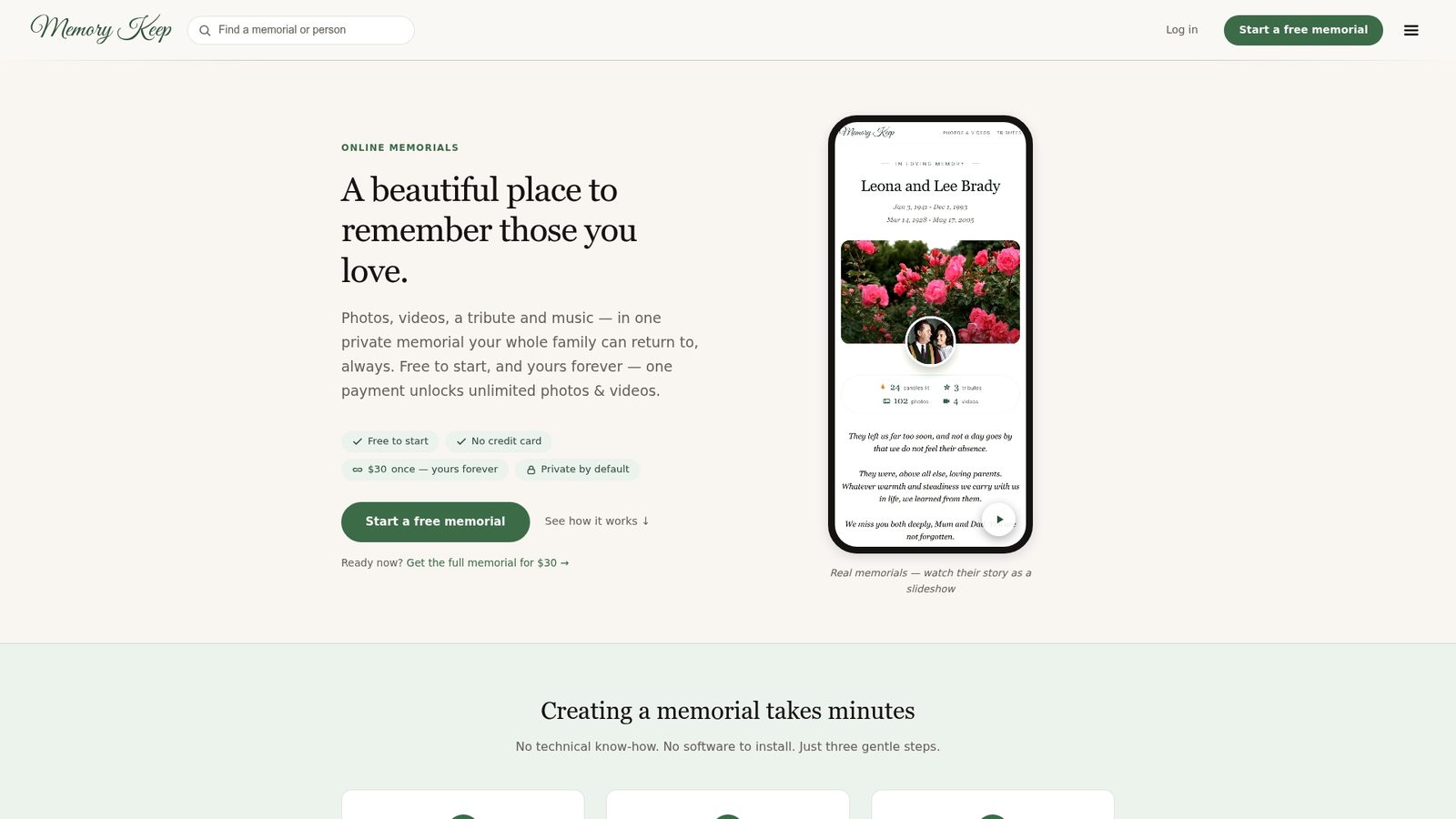
The free plan lets you start a memorial with basic uploads, and a one-time $30 upgrade unlocks unlimited photos, videos, and storage for that memorial permanently, with no recurring fee. Families use these pages to share a slideshow from decades of family gatherings, host a livestream link for the funeral itself, collect guestbook messages from friends scattered across the country, and generate a QR code that goes straight onto a headstone, urn, or memorial card. Take a look at how it comes together on a real page like Buddy’s memorial, then start building one for your own family at Memory Keep.
Sources
For more detail beyond these examples, a few resources are worth bookmarking:
- Funeral
- How to Write an Obituary: Step-by-Step Guide | GenealogyBank blog
- How to Write an Obituary: Step-by-Step Guide | Grammarly
- Obituary Writing Toolbox: Template and Samples | Star Tribune