
Use a single targeted prompt and a 10 minute freewrite to find a specific memory that will become the heart of your tribute. Tribute writing prompts work because they trade a blank page for a small, answerable question. You don’t have to summarize a whole life in one sitting. You just have to remember one moment.
Pick one category, memory, character, legacy, or relationship, and let it lead you.
- Memory: What small detail do you not want to forget?
- Character: What did they say or do so often it became their signature?
- Legacy: What did they teach you that you now pass on?
- Relationship: What do you wish you’d told them one more time?
Set a timer for ten minutes and write without editing. Whatever comes out is your starting material. If you’re gathering memories from others too, a place like Memory Keep gives everyone a single link to add their own story, so the tribute becomes something the whole family builds together.
Key Takeaways
A targeted prompt paired with a short, timed freewrite is the fastest reliable path from a blank page to a specific, authentic tribute.
| Point | Details |
|---|---|
| Start with one prompt | Choose memory, character, legacy, or relationship, then freewrite for ten minutes without editing. |
| Keep spoken length in range | Aim for 100 to 150 words per minute and 500 to 900 words for a 3 to 5 minute tribute. |
| Follow the five-part shape | Structure around an opening, who they were, two to three stories, impact, and a closing. |
| Edit for balance and pace | Check your “I” versus their name ratio and mark pause points before you deliver it aloud. |
| Collect shared memories in one place | Memory Keep centralizes photos, video, and written tributes on one shareable memorial link. |
Table of Contents
- What Is a Tribute and What Should It Include?
- Tone, Voice, and the Pitfalls That Weaken a Tribute
- Memory Prompts to Surface Specific Moments
- Character Prompts That Reveal Who They Were
- Legacy Prompts: Turning What They Left Behind Into a Closing Message
- Relationship Starters and Quick Templates by Role
- Short Keepsake Lines for Cards and Online Memorials
- Structure and Delivery: Timing, Pace, and Staying Calm
- Collecting Shared Tributes for an Online Memorial
- Why Prompts Matter More Than Perfect Words
- Turn These Prompts Into a Memorial the Whole Family Can Visit
- Frequently Asked Questions
- Sources
What Is a Tribute and What Should It Include?
A tribute, whether spoken at a service or written for an online memorial, is a short piece that shows who someone was through specific stories rather than general praise. It’s less a biography and more a portrait made of a few well chosen scenes.
If you’re speaking aloud, pace matters more than most people expect. Professionals recommend about 100 to 150 words per minute, which puts a comfortable tribute at a natural length for speaking without rushing.
Pro Tip: Read your draft aloud once with a stopwatch. If you’re rushing to finish, you’re either over the word count or reading too fast for the room.
A five-part structure keeps the piece focused and much easier to edit:
- An opening that names who you’re honoring and your connection to them
- A brief sense of who they were, their role, their era, their spirit
- Two or three stories that prove a central trait or theme
- The impact they had on you or on others
- A closing farewell or final wish
Tone, Voice, and the Pitfalls That Weaken a Tribute
Your natural speaking voice will always land better than borrowed, formal language. Short sentences carry emotion more cleanly than elaborate ones, and that’s especially true if the piece will live permanently on an online memorial page, where readers return to it long after the service.
- Read your draft and count how often you say “I” versus their name; if “I” wins, shift the focus back to them.
- Choose one or two specific, true details over five generic compliments.
- Let a little humor in if it fits their personality. Grief professionals note that gentle humor tied to who someone actually was can be genuinely healing for a room.
- Skip phrases like “she was always there for everyone” and replace them with the moment that proves it.
Pro Tip: If a line could describe almost anyone, cut it. A tribute earns its power from the details no one else would think to include.
Memory Prompts to Surface Specific Moments
Specific questions pull out better material than broad ones. Asking who, when, where, and what they were doing draws out memorable anecdotes far more reliably than a general question like “what was she like?” Pick two or three of the prompts below and freewrite for ten minutes without stopping to edit.
- What small detail do I not want to forget, the way their kitchen smelled, the song they hummed, the way they laughed?
- What did they do every single week, without exception?
- What’s a moment that still makes me smile when I think about it?
- What did their hands look like when they were doing something they loved?
- What’s a phrase I can still hear them saying?
- Where did I feel most at ease with them, and what did that place look like?
- What’s a memory involving food, a specific meal, a recipe, a shared table?
- What was the last ordinary, unremarkable day I remember with them?
Pro Tip: Timed freewriting matters here more than it seems like it should. Setting a ten-minute limit forces raw, unedited memory to the surface before your inner editor starts trimming the good parts.
Character Prompts That Reveal Who They Were
Character prompts help you find the trait that will hold your whole tribute together. Once you know the theme, you can choose stories that prove it instead of listing traits without evidence.
- What word would people who knew them well use to describe them?
- What did they say so often it became a kind of catchphrase?
- What habit or ritual was uniquely theirs?
- How did they treat people who couldn’t do anything for them?
- What would they never tolerate, and what would they always forgive?
A single answer can become a tribute’s opening line. “What word would people use?” answered with “stubborn, in the best way” might turn into: “Everyone who knew my father knew he never once backed down from a fight worth having.” That’s a theme you can build three stories around.
Legacy Prompts: Turning What They Left Behind Into a Closing Message
Legacy prompts help you name what continues after someone is gone, which makes for a closing line that feels earned rather than borrowed from a card.
- What did they teach me that I now do without thinking?
- What tradition of theirs do I want to keep alive?
- What value did they model that I try to live up to?
- What would they want us to do with our grief?
- What’s one way I can honor them going forward?
A legacy answer translates directly into an ending. If the answer is “she taught me to call people back the same day,” the closing might read: “So today, in her memory, answer someone’s call. That was her whole philosophy in one habit.” You can also close by inviting guests to add their own memory to a shared memorial, turning the ending into a beginning for everyone else’s contribution.
Relationship Starters and Quick Templates by Role
Different relationships call for different openers. These starters work for both short and longer formats.
- For a parent: “My mother taught me that ___ before she ever said a word about it.” Scale up by adding a second story about how that lesson showed up later in your life.
- For a partner: “We had twenty years of ordinary Tuesdays, and I would take every one of them again.” Extend with a story about a shared routine or a hard year you got through together.
- For a friend: “I met ___ on a day I don’t remember, but I remember every day after.” Add one story that captures how the friendship actually worked, the running joke, the standing plan.
- For a colleague: “You could always tell who’d worked with ___, because they picked up the same habit of ___.” Follow with a specific work memory that shows their character on the job.
For a 1 to 3 minute tribute, use one story. For 3 to 5 minutes, use two or three, and close with a single sentence that sums up what they meant to you.
Short Keepsake Lines for Cards and Online Memorials
Not every tribute needs to be a full speech. Some of the most meaningful lines are a single sentence left in a guestbook, printed on a card, or posted to a memorial page.
- Comforting: “Grief is love with nowhere to go, but you gave us so much to hold onto.”
- Grateful: “Thank you for every ordinary day that turned out to be extraordinary.”
- Funny: “You’d tell us not to cry too much, and then you’d crack a joke to make sure we didn’t.”
- Spiritual: “You’ve gone ahead, but you left the porch light on for the rest of us.”
Pro Tip: Take one paragraph from your longer draft and edit it down to a single sentence. That compression often produces the line people remember most.
Structure and Delivery: Timing, Pace, and Staying Calm
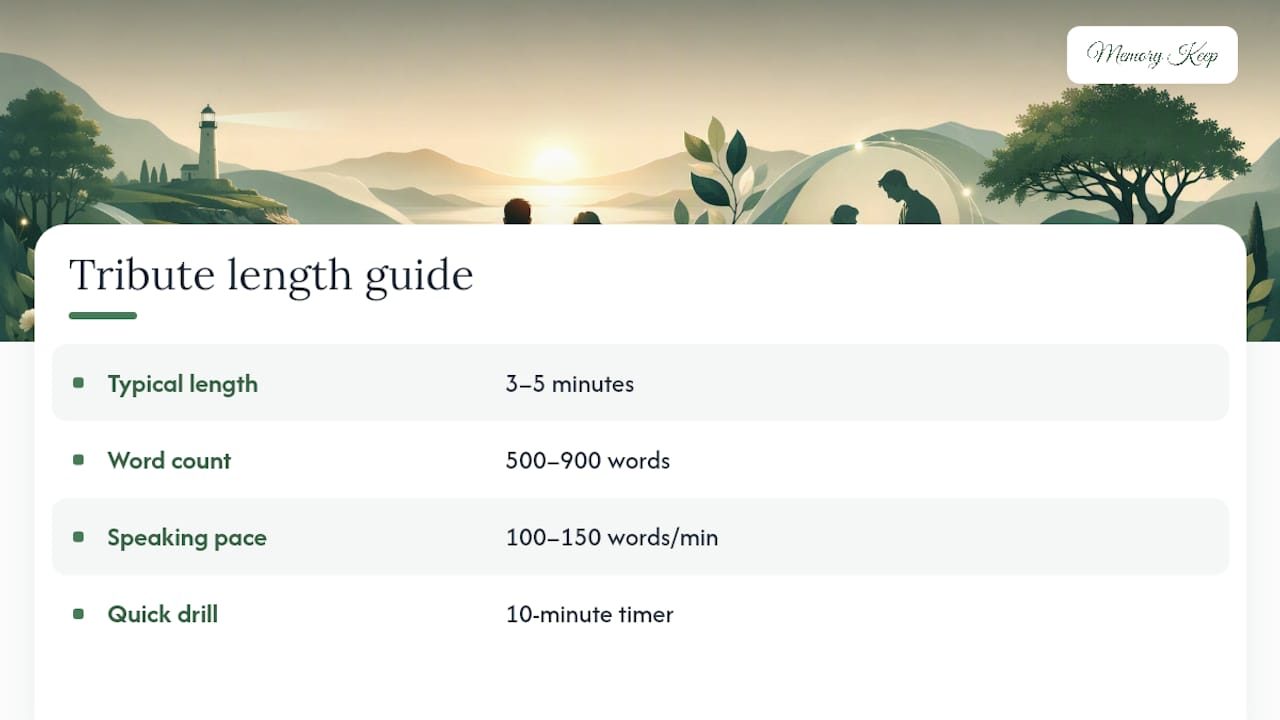
Grief changes how the body handles pressure, so a solid delivery plan matters as much as the writing itself. Aim for 100 to 150 words per minute, which keeps a 3 to 5 minute tribute in the 500 to 900 word range without forcing you to rush.
- Print your script in a large, easy-to-read font with wide spacing, and number every page in case you drop them.
- Have a glass of water nearby and a backup reader ready in case emotion takes over mid-sentence.
- Do two full read-throughs out loud, then one timed practice run. That routine reduces delivery anxiety and surfaces awkward phrasing before it trips you up in front of a room.
- Mark two or three spots in the margin where you can pause if you need a breath.
Before your final draft, run this edit checklist: trim to two or three stories maximum, tally your “I” versus their name and rebalance if needed, and read the whole thing aloud one last time for pacing.
Collecting Shared Tributes for an Online Memorial
You don’t have to write a tribute alone, and often the richest one comes from more than one voice. Inviting others to contribute produces a fuller, more varied portrait than any single writer can manage, and it eases the weight on whoever’s holding the pen.
- Send one specific prompt, not an open-ended request, to each contributor. “What’s your favorite memory of her at the lake house?” gets better answers than “share a memory.”
- Set a short limit, one paragraph or 100 to 200 words, so you can weave contributions together without editing a dozen essays.
- Use a centralized page where photos, audio, video, and written memories all land in one place instead of scattered texts and emails.
- Try sending the same prompt to three people, then blend their answers into one paragraph that captures the overlap in how they remember your loved one.
Pro Tip: A dedicated memorial link makes this far easier than a group text. Everyone contributes on their own time, and nothing gets lost in a thread.
Why Prompts Matter More Than Perfect Words
We’ve watched families sit down to write a tribute with the best intentions and the worst tool: a blank page and no starting point. That’s where things stall. A good prompt doesn’t ask you to summarize a life. It asks you to remember one afternoon, one phrase, one habit, and that’s a question almost anyone can answer, even through tears.

Start with one prompt. Write badly if you have to. Then invite someone else to answer the same question, because the memory you’re missing is often sitting in someone else’s mind, waiting to be asked for.
Turn These Prompts Into a Memorial the Whole Family Can Visit
Once you’ve written a tribute, or a dozen shared memories from different relatives, you need somewhere lasting to put them. Memory Keep gives every memorial a unique, shareable link, so instead of a printed program that gets tucked in a drawer, the tribute lives on a page anyone can revisit and add to.
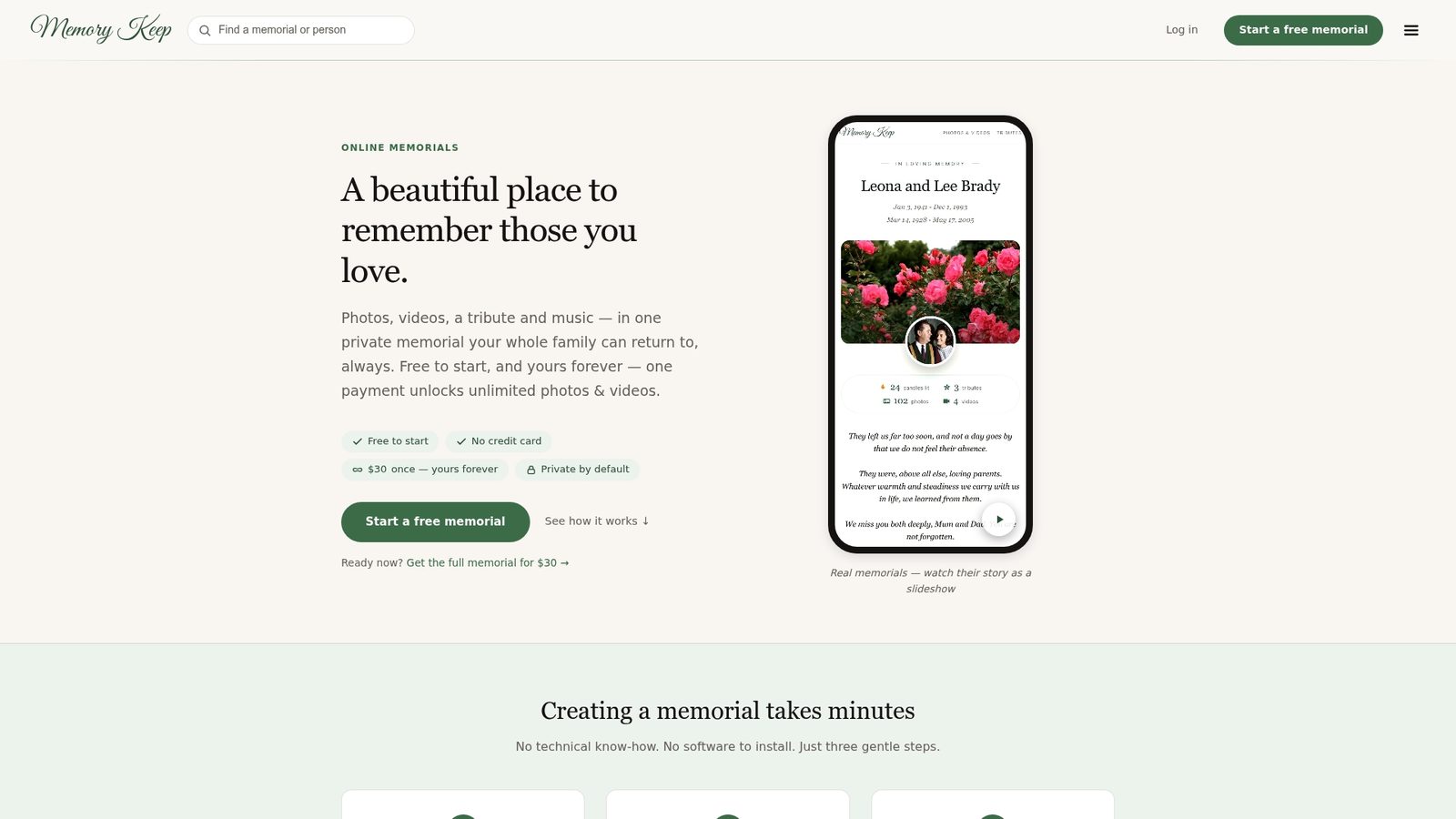
The platform is built for exactly the collaborative work described above: family and friends can upload their own photos, videos, and written tributes directly to the page, no single person has to collect and retype everyone’s contributions. You can also generate a QR code that links straight to the memorial, perfect for a headstone, a printed card, or a keepsake box. Browse a finished example, like the memorial page for Dixie, to see how photos and written tributes come together on one page. When you’re ready, start building a memorial and send the link to everyone who has a memory worth adding.
Frequently Asked Questions
How long should a tribute or eulogy be? Most spoken tributes run 3 to 5 minutes, which works out to roughly 500 to 900 words at a natural speaking pace of 100 to 150 words per minute.
What if I only have a few minutes to write something? Pick one memory prompt, set a timer for ten minutes, and write the first true story that comes to mind. One strong, specific memory beats a rushed attempt to cover everything.
Can I use tribute writing prompts for an online memorial instead of a spoken eulogy? Yes. The same prompts work well for written tributes, guestbook entries, and memorial page contributions, just trim your answer down to a sentence or short paragraph.
How do I get family members to contribute their own memories? Send each person one specific, easy-to-answer prompt rather than an open request, and set a short length limit so the answers are easy to weave together later.

What’s the biggest mistake people make when writing a tribute? Leaning on generic praise instead of specific stories. A single vivid detail, a phrase they always said, a habit only they had, does more work than five general compliments.
Sources
For more structure and delivery coaching, see Heather Stang’s eulogy prompts and Memory Keep’s guide to writing a eulogy or a full life story for a memorial.
- Eulogy Writing Prompts to Help You Write a Heartfelt Funeral Speech
- Writing a Heartfelt Online Tribute: Examples and Prompts
- How to Write and Deliver a Funeral Tribute: Guidance from a Professional Celebrant
- How to Write a Eulogy: A Step-by-Step Guide (With Examples and Templates)