

Search the Veterans Legacy Memorial first. It’s the official platform where the nation keeps veteran memorial pages, and it holds records for more than 10 million service members interred in national, military, and select private cemeteries. If you already have a private, family-made tribute in hand, like a shared Memory Keep link, you can open that directly to see photos, stories, and messages from loved ones.
Here’s the fastest path to what you’re looking for:
- Go to Vlm and search by first and last name.
- If a family member sent you a private memorial link or a QR code, tap it. It will open immediately, no search required.
- If you’re building a page yourself rather than searching for one, a platform like Memory Keep lets you create a shareable tribute in minutes.
Key Takeaways
Finding a veteran memorial page starts with the Veterans Legacy Memorial for verified service records, and pairing it with a private, family-built tribute preserves the personal history no government database was designed to hold.
| Point | Details |
|---|---|
| Start with VLM | Search Veterans Legacy Memorial by first and last name, then narrow with cemetery or branch filters. |
| Check active-duty losses separately | Service members who died on active duty since 1985 may appear on Military In Lasting Tribute instead. |
| Don’t confuse profiles with benefits | A memorial page existing does not mean burial benefits like headstones or flags have been claimed. |
| Verify missing records elsewhere | If no profile turns up, check cemetery locators, obituaries, or private burial records before assuming an error. |
| Add a private memorial for the full story | Memory Keep lets families build a shareable, media rich tribute alongside the official record. |
Table of Contents
- Where to Find a Veteran Memorial Page Online
- How Do You Search for a Specific Veteran’s Memorial Page?
- What Can You Do on a Veteran’s Memorial Page?
- Who Is Eligible for an Official Veteran Memorial Page?
- How Do Memorial Pages Connect to VA Burial Benefits?
- Why Some Families Choose a Private Memorial Alongside the Official Record
- What Actually Matters When You’re Looking for a Veteran’s Page
- Building a Family Memorial That Goes Beyond the Official Record
- Official Resources and Grief Support
- Sources
Where to Find a Veteran Memorial Page Online
The Veterans Legacy Memorial is the place to start. Run by the National Cemetery Administration, it hosts profiles for veterans and service members buried in VA national cemeteries, VA grant-funded state and tribal cemeteries, and some military-managed cemeteries like Arlington. A typical profile shows service branch, rank, dates of birth and death, and a grave location, and many include uploaded photos and written tributes from family or fellow veterans.
For service members who died on active duty rather than in retirement or after discharge, Military In Lasting Tribute fills a specific gap. This Military OneSource platform covers those who died while serving honorably from 1985 to the present, including peacetime losses that sometimes don’t fit neatly into national cemetery records.
Between these two platforms, the coverage is wide, but not universal:
- National cemeteries and VA grant-funded state/tribal cemeteries feed into VLM automatically.
- Active-duty deaths since 1985 may also appear on Military In Lasting Tribute.
- Veterans buried in private cemeteries with no VA affiliation typically won’t appear on either.
How Do You Search for a Specific Veteran’s Memorial Page?
Getting the name format right matters more than people expect. VLM’s search tool works best with a clean First Last entry, no commas, no rank prefixes like “Sgt.” or “Capt.” If that search comes up empty, try again with a middle initial included or dropped, since record entries aren’t always consistent.
- Search by first and last name only, then narrow with a middle initial if you get too many results.
- Add a cemetery name if you know it. This filter alone often narrows dozens of matches down to one.
- Filter by branch of service or year of death when the site offers it.
- If you still can’t find the record, try the cemetery’s own locator tool or check a published obituary for a direct link.
- Ask family members directly. Many veterans now have a private tribute page, and someone in the family may already have that link or QR code saved.
Pro Tip: Common names like “John Smith” can return dozens of hits. Narrow by cemetery first, not branch of service. Cemetery affiliation eliminates far more false matches than military branch does.
If multiple profiles look plausible, cross-check the birth and death years against what you already know. If nothing turns up at all, the veteran may be buried in a cemetery outside VLM’s scope, which is common and doesn’t reflect on their service record.
What Can You Do on a Veteran’s Memorial Page?
Once you land on the right profile, there’s usually more to see than a name and a date. VLM pages built from instructions on the official site typically include a service branch emblem, rank, decorations if listed, a short biography, and any photos or documents the family or community chose to upload.
Visitors generally have a few respectful options:
- Post a tribute message honoring the veteran’s service or memory.
- Upload a photo, when the profile allows public contributions.
- Share the page link with other family members or veteran organizations.
The experience differs depending on the platform. Government-run pages emphasize verified service records, which is exactly what Digital VA’s own framing of these tools describes: recognition rooted in documented history. Private memorial sites lean the other way, prioritizing personal storytelling, family photos, and video over formal record-keeping. Either way, posting etiquette matters: keep language respectful, avoid political commentary, and get a family member’s blessing before uploading personal photos that aren’t already public.
Who Is Eligible for an Official Veteran Memorial Page?
Eligibility comes down almost entirely to where and how a veteran is buried. Three categories make up nearly all VLM coverage:
- Veterans interred in VA national cemeteries.
- Veterans buried in VA grant-funded state or tribal veterans’ cemeteries.
- Service members in certain military-managed cemeteries, including Arlington National Cemetery.
Service members who died while on active duty from 1985 forward may also have a page on Military In Lasting Tribute, which accepts submissions to add names that are missing.
If you’ve searched and found nothing, don’t assume the veteran was overlooked. Private cemetery burials, older records that predate digital cataloging, and clerical gaps are all common reasons a profile might not exist yet. Checking the cemetery’s own records or a published obituary often fills in what the national platform hasn’t caught up to. Families in that position can also build a private tribute themselves rather than waiting on an official record to appear.
How Do Memorial Pages Connect to VA Burial Benefits?
A memorial page and a benefits claim are two entirely separate things, and conflating them causes real confusion for grieving families. Having a profile on VLM does not mean a family has received, or automatically qualifies for, VA burial benefits.
Those benefits are handled through a separate process and can include:
- A government headstone or marker.
- A burial medallion.
- A Presidential Memorial Certificate.
- A burial flag.
- In specific circumstances, partial reimbursement of burial costs, though the VA does not directly cover cremation expenses in most cases.
If you’re trying to confirm what a family is owed rather than just viewing a tribute, the National Cemetery Administration’s benefits page is the accurate starting point, not the memorial profile itself.
Why Some Families Choose a Private Memorial Alongside the Official Record
Official platforms exist to preserve verified service history, and they do that well. What they’re not built for is the fuller story: the grandkids who called him “Pop,” the fishing trips, the voice on an old home video. That’s the gap private memorial platforms fill, and it’s why families increasingly maintain both.
Memory Keep, for instance, gives families a dedicated page with unlimited photos, video, and audio, plus a unique link and QR code that can go straight onto a headstone or a printed card. Relatives scattered across the country can upload their own photos to the same page rather than passing files around by email, and the family can later order a keepsake photo book or slideshow from what’s been gathered.

Organizations like TAPS have long noted that shared memorial spaces help military families turn private grief into something collective. If you’re supporting a grieving friend or relative through this process, practical guidance on how to help can make the conversation easier.
Pro Tip: Keep the official VLM link and your private memorial link together in one place, a pinned family text or a shared note, so future generations have both without hunting.
What Actually Matters When You’re Looking for a Veteran’s Page
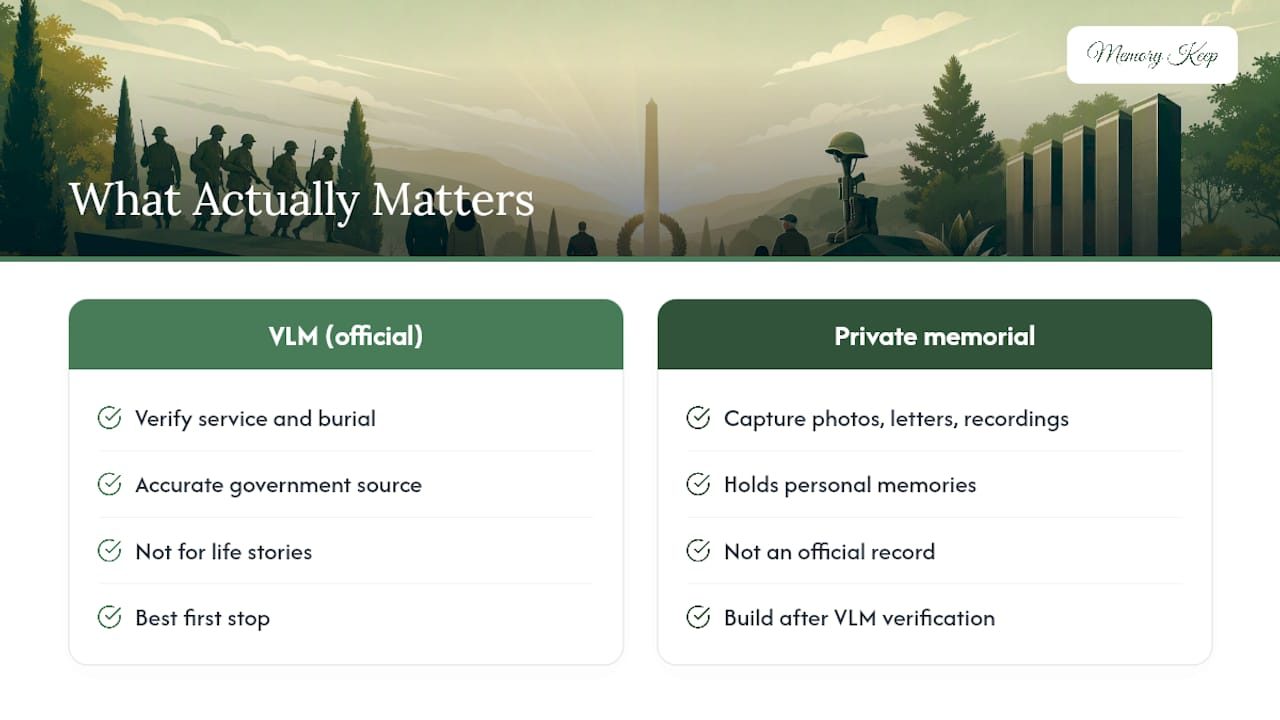
Most guides treat the search for a veteran memorial page as a pure lookup problem: type a name, get a result, done. That framing misses what actually happens in practice. A huge share of searches fail not because the veteran lacks a record, but because the searcher doesn’t know the cemetery, gets tripped up by a common name, or assumes a private burial means no digital record exists anywhere.
The bigger miss in conventional advice is treating VLM as the only stop. It’s the right first stop for verifying service history, but it was never designed to hold a life story. Families who stop there often feel like something is missing, and it is. The photos from a 90th birthday, the letters home from deployment, the voice recording nobody digitized until it was almost too late. None of that belongs in a government record, and none of it will ever appear there.
Our honest read: search VLM first for accuracy, then build a private memorial for everything the official record was never meant to hold. Treat them as two different jobs, not competing options.
Building a Family Memorial That Goes Beyond the Official Record
A Veterans Legacy Memorial profile confirms service and burial details, but it wasn’t built to hold a family’s actual memories, and it was never meant to. That’s the gap Memory Keep exists to fill for veterans’ families who want a fuller tribute they control completely.
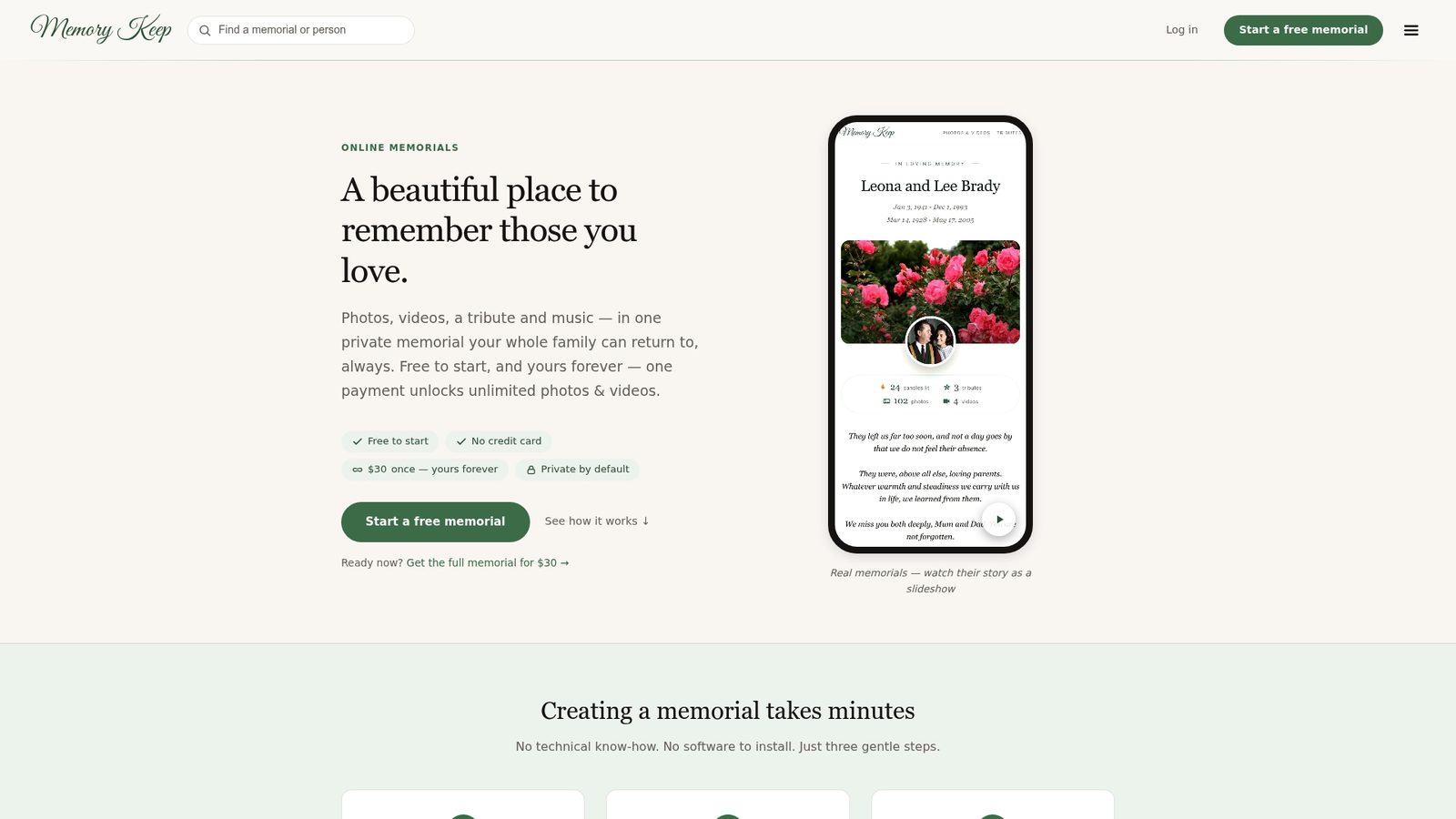
With Memory Keep, you get a dedicated page for unlimited photos, videos, and audio, a unique shareable link, and a QR code you can have engraved on a headstone or printed on a memorial card. The free plan covers basic uploads, and a one-time $30 upgrade unlocks unlimited storage and features permanently, no subscription, no renewal. Family and friends anywhere can contribute their own photos directly to the page, and visitors can leave messages of remembrance the way they would sign a guestbook.
If you want to see what a finished page looks like before starting your own, browse an example memorial for a sense of layout and tone. When you’re ready, start building a memorial page for the veteran in your family today.
Official Resources and Grief Support
- VA burial and memorial benefits — headstones, flags, and reimbursement details.
- Military In Lasting Tribute — memorial for active-duty service members since 1985.
- Twelve Essential Grief Insights — support for families navigating loss.
Sources
- Veterans Legacy Memorial — VLM (Official site)
- Military In Lasting Tribute — Military OneSource
- VA burial and memorial benefits — National Cemetery Administration