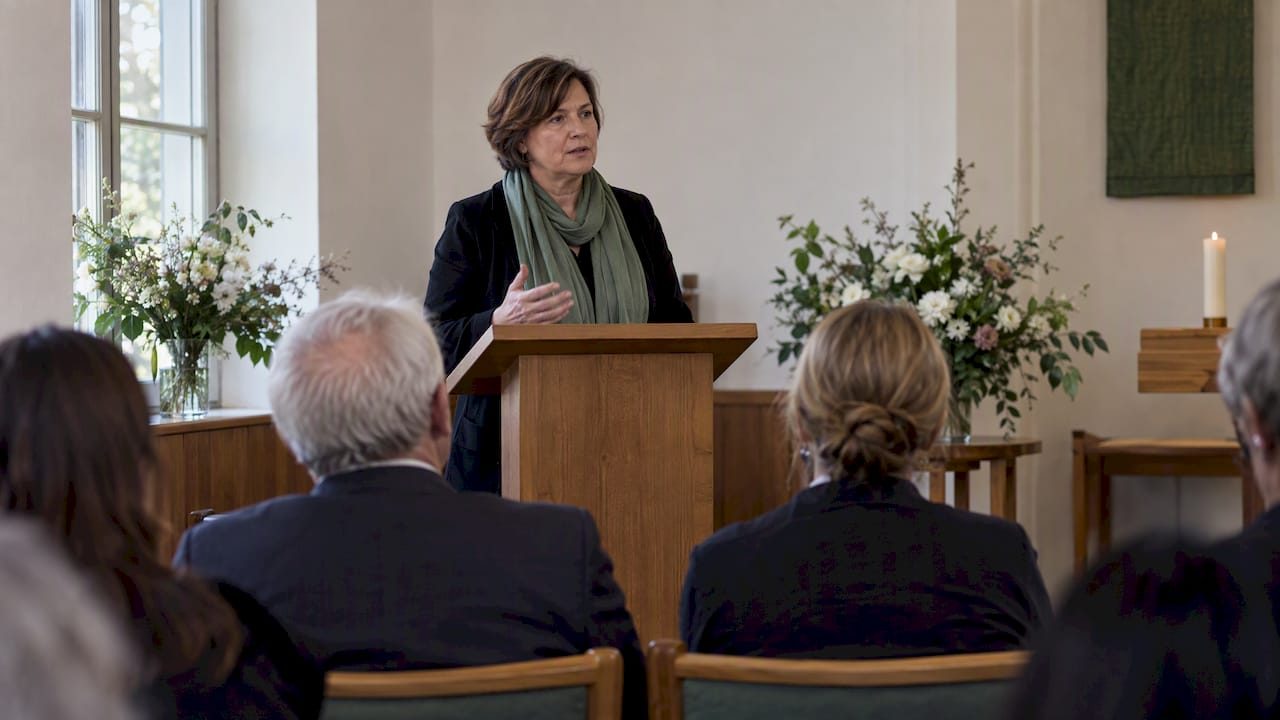

A eulogy is a formal speech given at a funeral to honor the life of the person who died and to comfort those grieving, while a tribute is a broader act of honoring someone that can take many forms, from a short speech to a song, a photo montage, or a shared memory on a page like Memory Keep.
TL;DR:
- Eulogies typically last 3 to 5 minutes and are delivered at funerals by someone close to the deceased, focusing on praising the person’s life and offering comfort.
- Tributes are broader and can take various forms, including speeches, photo montages, videos, or written notes, often used in celebration of life events.
- The choice depends on the event type, relationship, audience needs, and emotional goals, with eulogies suited for closure and tributes for collective remembrance.
- Cultural and religious traditions influence the format, with some communities favoring multiple short tributes over formal eulogies or incorporating music and action.
- Formal guidance advises keeping eulogies personal, authentic, and time-bound, while tributes should focus on one true, heartfelt message, regardless of format.
Table of Contents
- What is a eulogy and what is a tribute?
- Eulogy vs tribute: a practical comparison
- How do you decide: eulogy or tribute?
- Writing and delivering each one well
- Short templates you can adapt today
- Where to find more guidance and templates
- Where eulogies and tributes come from
- How culture shapes the eulogy and the tribute
- Why the emotional weight differs between the two
- Are there any formal rules for eulogies or tributes?
- Why we think clarity here matters
- FAQ
- Sources
What is a eulogy and what is a tribute?
A eulogy is a specific kind of speech. It is typically delivered at a funeral or memorial service, usually by someone close to the deceased, and it walks through the person’s life, character, and impact. According to a public speaking textbook on eulogies, the form works on two levels at once: it praises the person who died, and it consoles the people left behind. That second part matters more than many realize. A eulogy is written for the room, not just for the memory.
A tribute is looser. It can be a speech too, but it does not have to be. Ceremonial-speaking guidance from Puget Sound treats tribute as its own genre, separate from eulogy, often calling for a more polished or elevated style because it can appear in settings beyond funerals.
Common formats and settings include:
- A spoken tribute at a celebration of life, sometimes alongside several other short tributes.
- A photo or video montage played during a service or shared online afterward.
- A written tribute posted to a memorial page, read aloud by an officiant, or printed in a program.
- A dedication, toast, or award remembrance delivered at an anniversary or institutional event.
Eulogy vs tribute: a practical comparison
Once you see the two side by side, the choice usually becomes obvious.
Purpose and audience. A eulogy’s job, according to rhetorical research on eulogies, is to praise the deceased while easing the grief of the people listening. A tribute can do that too, but it can also simply celebrate someone’s life, work, or milestone without the weight of a funeral setting attached to it.
Tone and structure. A eulogy tends to follow a narrative arc: who this person was, how they lived, what they meant to others. A tribute has no required shape. It might be one sentence read aloud, a slideshow set to music, or a collaborative page where friends each add a memory.
Timing and length. Eulogies typically run 3 to 5 minutes, timed to fit within a single funeral service. Tributes vary widely. One person might speak for ninety seconds; another might contribute a line to a shared memorial or record a short video message beforehand.
A few examples make the contrast concrete:
- A daughter’s 4-minute speech about her father’s quiet humor and steady presence is a eulogy.
- A coworker’s two-line tribute shared on a memorial page, or a slideshow of family photos played during the reception, is a tribute.
How do you decide: eulogy or tribute?
Start with a short checklist before you write a single word.
- What is the event? A funeral or formal memorial usually calls for one eulogy. A celebration of life, wake, or online memorial page welcomes multiple shorter tributes.
- What was your relationship to the person? Immediate family or a closest friend often delivers the eulogy. Coworkers, extended family, and friends usually contribute tributes.
- Who is in the room? If the audience needs comfort and context about a life well lived, lean eulogy. If the goal is to let many voices be heard, lean tribute.
- What is the emotional goal? Consolation and closure point to a eulogy. Celebration, connection, or collective remembrance point to a tribute.
Many services use both: one formal eulogy from a family member, plus several short tributes from others, woven together by the officiant so the service feels cohesive rather than repetitive.
If you cannot speak, write your tribute and hand it to the officiant to read, or record a short video message in advance.
Pro Tip: If you are nervous about speaking, write your words down anyway. A written tribute still counts, and it can be read aloud or preserved exactly as written.
Writing and delivering each one well
A eulogy works best when it stays personal and specific. Pick two or three real stories rather than trying to summarize an entire life. Rhetorical guidance on eulogies notes that authenticity matters more than polish, and that eulogies succeed when they console the living, not just when they describe the dead.
For eulogies:
- Open with who the person was to you, then move into one or two illustrating memories.
- Keep it within the typical 3 to 5 minute window so the service stays on schedule.
- Close by looking forward, offering some comfort to those listening.
For tributes:
- Choose the format that fits the setting: a short speech, a song, a montage, or a written note.
- If several people are contributing, coordinate so the tributes do not repeat the same stories.
- Multimedia helps here in a way it rarely does in a formal eulogy. Photos and music can carry what words cannot.
Avoid these at either: clichés like “they’re in a better place,” comments that sound like judgment of the death itself, and anything political or divisive. Funeralwise’s guidance on what not to say to the bereaved offers alternatives that land softer and feel more genuine.
For delivery, bring printed notes even if you plan to speak mostly from memory, practice out loud at least once, and give yourself permission to pause if emotion catches up with you. Our step-by-step guide to writing a eulogy walks through the process in more detail if you want extra structure.
Short templates you can adapt today
You do not need to start from a blank page. Funeralwise’s eulogy structure breaks a mini-eulogy into three simple parts.
- Opening (one sentence): State who the person was and your relationship to them. “My mother raised four kids and somehow still had time to teach half the neighborhood to bake.”
- Memory (one or two sentences): Share a specific moment that shows their character. “She once drove two hours in a snowstorm because I forgot my science project at home. She never once mentioned it again.”
- Closing (one sentence): Offer comfort or look forward. “I carry her patience with me now, and I hope to pass it on.”
For a shorter tribute, one sentence can be enough: “Grandpa taught me that kindness takes no effort and means everything.” A slightly longer tribute might read: “She filled every room she walked into. We will miss her laugh most of all, and we are grateful for every year we had with her.”
A photo-montage caption can be as simple as: “Forty years, countless memories, one remarkable life.”
Once written, these words are worth keeping somewhere permanent. A page on Memory Keep lets family and friends store a eulogy, a tribute, or a whole collection of them alongside photos and videos, so they are not lost in a folder or forgotten after the service.

Where to find more guidance and templates
If you want to see the full structure behind a eulogy before you write one, Funeralwise’s eulogy guide breaks down the three common themes: biographical, personal, and specialized. For tribute ideas beyond a spoken speech, our list of creative ways to honor a loved one covers photo montages, memory donations, and collaborative projects families can build together.
- How to write a eulogy, step by step
- Creative tribute ideas for a loved one
- What to say when someone dies
If the writing itself feels like too much right now, that is common. Grief has no fixed timeline, and it is reasonable to ask a friend or family member to help draft a few lines with you.
Where eulogies and tributes come from
The word “eulogy” comes from Greek roots meaning “good words,” and the practice of formally praising the dead stretches back to ancient funeral oratory, where public speeches honored soldiers, leaders, and citizens alike. Over centuries, the form moved from public squares into churches and, eventually, into funeral homes and living rooms.
Tribute has a separate, broader history. It originally referred to something given or paid as a mark of respect, often to a ruler or institution, long before it came to describe a speech or gesture honoring a person who died. That older, wider meaning is part of why a tribute today can be a song, a donation, a planted tree, or a line on a memorial page, not only a speech.
As funerals moved away from strict religious scripts in many communities, both forms loosened. Celebrations of life introduced room for humor, music, and multiple voices, which gave tributes more space to grow alongside the traditional eulogy. The two forms now sit comfortably together in most modern services, each doing a slightly different job.
How culture shapes the eulogy and the tribute
Not every tradition uses a eulogy the same way, or uses one at all. Some religious services favor set prayers and readings over personal speeches, reserving warmer, more personal tributes for a separate gathering like a wake or a celebration of life held on another day.
Other cultures build an entire service around multiple short tributes rather than a single formal eulogy, inviting many voices so that no one person is asked to summarize a whole life alone. In some communities, music, dance, or shared meals carry as much weight as spoken words, folding tribute into action rather than language.
These differences are worth knowing before you plan or attend a service outside your own tradition. Asking the officiant or family what is expected, a eulogy, a few short tributes, or something else entirely, avoids an awkward surprise and shows respect for how that family chooses to grieve.
Why the emotional weight differs between the two
A eulogy carries a particular kind of pressure because it is usually singular. One person stands up, speaks for a few minutes, and attempts to hold an entire life and an entire room’s grief at once. Rhetorical research on the form frames this clearly: the eulogy’s deeper purpose is consolation, not biography, which is why a shaky voice or a pause to cry rarely detracts from it.
A tribute spreads that weight across more people and more formats, which changes how it feels both to give and to receive. A short tribute from a coworker does not need to carry the whole story. It only needs to add one true thing to a larger picture that other tributes, and often the eulogy itself, are also building.
That difference in weight is worth remembering if you are asked to contribute but feel unsure you can do the subject justice. A tribute does not require you to say everything. It asks you to say one honest thing well.
Are there any formal rules for eulogies or tributes?
There is no legal requirement to deliver a eulogy or tribute at a funeral, and no governing body certifies who may speak. Religious or denominational guidelines sometimes shape what is allowed within a particular service. Some traditions limit personal eulogies during the formal liturgy and instead place them at a separate visitation, reception, or celebration of life.
Funeral homes and officiants generally set practical expectations rather than legal ones: a requested time limit, a request to submit written remarks in advance, or a preference for how many speakers the service can accommodate. Guidance on funeral elements and roles notes there is no required number of eulogies or tributes at a service, which leaves the structure largely up to the family and the officiant leading it.
The one practical safeguard worth remembering: if you are asked to speak but worry about composure or appropriateness, give your written remarks to the officiant ahead of time. They can read your words for you, or review them beforehand to make sure the content fits the tone of the service.
Why we think clarity here matters
Families planning a service already carry enough. Knowing whether you are writing a eulogy or a tribute, and what each one actually requires, removes one more decision from an already heavy week.
Neither form needs to be perfect. A shaky voice, a forgotten line, a tribute that is just one honest sentence: all of it still counts, and all of it still honors the person you are remembering. Our templates and collaborative memorial pages exist to make that easier, not to add pressure to get it right.
— Memory Keep
FAQ
What should you not say in a eulogy?
Avoid clichés like “they’re in a better place” or “I know how you feel,” which can feel hollow even when well intended. Funeralwise’s guidance on what not to say recommends focusing on specific, honest memories instead, which tend to comfort people more than generic reassurance.
What is a tribute called at a funeral?
It is usually just called a tribute, though some services label it a “remembrance” or a “memory share” when several people each contribute a short piece. It can be spoken, written, or shared as a photo or video montage.
What are the three parts of a eulogy?
A simple eulogy structure has an opening that states who the person was to you, one or two specific memories that show their character, and a closing line that offers comfort or looks forward. Funeralwise’s eulogy guide outlines this three-part shape as a reliable starting point for most speakers.
Why do some religious services skip the eulogy?
Some denominations keep the formal funeral liturgy focused on prayer and scripture rather than personal speeches, reserving warmer remembrances for a separate gathering like a wake or celebration of life. This varies by faith and even by individual congregation, so it is worth asking the officiant what the service includes.
Can a tribute be used instead of a eulogy?
Yes, many services use several short tributes instead of a single formal eulogy, especially at celebrations of life where multiple people want to speak. A family can also combine both: one eulogy from a close family member plus shorter tributes from others.
Sources
- Funeralwise — How to write a eulogy
- Funeralwise — Eulogy themes and guidance
- Public speaking textbook — Eulogy
- Puget Sound — Ceremonial speaking genres (eulogy and tribute)