

Writing an honest, specific memorial tribute and building a shareable online memorial page gives a man’s full story a lasting home, contradictions and all, and gives the people who loved him a gentle way to add their own memories over time. This guide gives you prompts, short templates, and a step-by-step checklist for setting one up. You can start that page today with Memory Keep.
TL;DR:
- Gather his dates, varied photos, and any audio, video, songs, or key locations; then choose private access or a shareable link or QR code.
- Ask relatives for one photo or a few lines, and make sharing optional; contributors can add memories without writing well or creating an account.
- Contact a doctor if sadness, withdrawal, or physical symptoms persist for months; seek immediate professional help for thoughts of self harm.
- Memory Keep’s Free plan has limited uploads, while its one time $15 Full plan includes unlimited photos, video, and storage without recurring fees.
Table of Contents
- Why writing and an online memorial help with grief
- Writing prompts and short templates for tributes
- Step-by-step: build, share, and invite others to a memorial page
- Common emotional challenges men face during grief
- Community groups and peer support for grieving men
- How grief affects men’s health and when to seek help
- Finding comfort beyond writing and memorial pages
- Encouraging men to speak openly about loss
- What families ask for and what actually works
- Start a memorial page with Memory Keep
- FAQ
- Sources
Why writing and an online memorial help with grief
Grief rarely moves in a straight line, and the instinct to tidy a man’s story into something simple can leave out the parts that made him real. Writing things down, even messily, gives grief somewhere to go besides around in circles.
Research on structured writing programs for bereaved people describes group writing paired with at-home diary tracks, a systematic writing program for grief processing, and found that this kind of repeated, guided writing supports narrative coherence, meaning the story starts to make sense as a story rather than a tangle of loss. A separate study of online therapeutic writing courses for bereaved people found that exercises like life chapters, acrostics, and compassionate letters help people build meaning and connect with others who are grieving in similar ways. Neither of these findings hinges on being a skilled writer. They hinge on being willing to put something down on the page.
An online memorial page gives that writing a second purpose: it becomes something others can read, respond to, and add onto. Memorial guidance from Stanford’s Medicine and the Muse program recommends making room for humor, ordinary stories, complicated feelings, and even silence, rather than smoothing a life into a single idealized version. A man who was stubborn, funny, difficult, and generous all in the same week deserves a tribute that holds all of that at once.
Practically, a memorial page does a few things a notebook cannot:
- It organizes photos, stories, and memories in one place instead of scattered across phones and group texts.
- It lets family members in different time zones or life stages add their own memories whenever they are ready.
- It stays accessible for years, so a memory someone could not write today might find its way there next year.
Expressive writing linked to narrative coherence in bereavement: combining free writing with focused prompts supports psychological adjustment after loss.
Writing prompts and short templates for tributes
Staring at a blank page is its own kind of grief. These prompts are built to lower that barrier, whether you are writing a short tribute, a few lines for a guestbook, or a fuller obituary.
- Start with a timer. Set ten minutes and write without editing. Answer the question: what do you want people to know about him that they might not already?
- Describe one ordinary day. Not the funeral, not the diagnosis. A Tuesday. What did he do first thing in the morning? What made him laugh that week?
- Write a short letter to him. Say the thing you did not get to say, or the thing you want to say again.
- Name three defining moments. They do not need to be dramatic. A fishing trip, a stubborn argument, the way he taught someone to drive.
Once you have raw material, shape it into something shareable:
- A 40 to 80 word tribute: one sentence on who he was, one specific memory, one sentence on what he leaves behind.
- A 150 to 250 word short obituary: his name, key dates, the people and places that mattered, and one detail that sounds like him rather than a form letter.
- A 2 to 3 sentence guestbook starter: “I remember when…” or “He taught me…” is enough to invite others to add their own lines.
Keep the voice close to how he actually talked, including the parts that were not polished. A workshop for fathers writing through grief, Fathers Writing Through Grief with Just Dads, frames memorial writing as an invitation rather than a test, noting that participants do not need to be writers or even share what they write for the exercise to matter. Humor belongs here too. So do contradictions. A man can be remembered as both gentle and hard to reach in the same tribute, and that honesty tends to land harder than a polished eulogy ever could.
Pro Tip: If writing feels impossible, start by listing five words other people use to describe him, then write one sentence for each. You already have a tribute.
Step-by-step: build, share, and invite others to a memorial page
Setting up an online memorial page is more straightforward than it feels in the first days after a loss. A few fields and a handful of photos are enough to start, and you can always add more later.
Before you begin, gather:
- His full name, birth and passing dates, and a short bio or the tribute you just wrote.
- A handful of photos that show different sides of him, not just posed portraits.
- Any audio or video clips, even short voicemails or home videos.
- A song or two that remind family of him, for a memorial’s music section.
- Key locations or milestones for a life-events map, like where he grew up, served, worked, or raised his family.
Once the page has its first layer of content, decide how to share it. A memorial page can stay private to invited family, or be shared more broadly through a unique link. Many families also generate a QR code for a printed program or a headstone marker, so anyone holding a program at a service can pull up the full page on their phone.
| Setup step | What it covers | Why it matters |
|---|---|---|
| Add core details | Name, dates, short bio | Gives visitors context before they read tributes |
| Upload media | Photos, audio, video | Shows the full person, not one moment |
| Set privacy | Private or shareable link | Controls who can view and contribute |
| Share access | Unique link or QR code | Makes the page easy to find and revisit |
When you invite others to contribute, keep the instructions simple: tell them they can upload a photo, write a few lines, or just leave a short note. Collaborative memorial building tends to work best when no one feels pressure to write something perfect. You can also lightly moderate what gets added, and many families later turn the finished page into a printable keepsake book or slideshow to keep alongside the digital version.
Common emotional challenges men face during grief
Men often describe grief as something they are expected to manage quietly, which can turn ordinary mourning into something more isolating than it needs to be. Pressure to “stay strong” for a family or a workplace can push feelings underground, where they tend to surface later as irritability, restlessness, or a sense of being unreachable even to people close by.
Some men lean on action instead of conversation: fixing something, staying busy, taking on tasks related to the loss. This is not avoidance by itself, but it can become isolating when action replaces every opportunity to talk or reflect. Others struggle most with the absence of a clear outlet. Grief support built around open conversation does not fit everyone, and a man who shuts down in a circle of chairs might open up completely with a pen in hand or a project to work on.
Tailored support tends to respect that range rather than forcing one mold. Writing privately, working alongside someone rather than facing them, or contributing to a shared project like a memorial page can all do the work that a traditional support conversation does for someone else. The goal is not to make a man grieve differently than he naturally would. It is to make sure he has at least one outlet that actually fits him.
Community groups and peer support for grieving men
Grief feels less isolating when it is witnessed by someone who understands it from the inside, and peer groups built specifically around men’s experiences can offer that without asking anyone to perform vulnerability on demand. Workshop settings designed for men, including writing-focused groups, tend to work precisely because they lower the pressure to speak. The fathers’ writing workshop model is built around this idea directly: participants write together, and sharing is entirely optional.
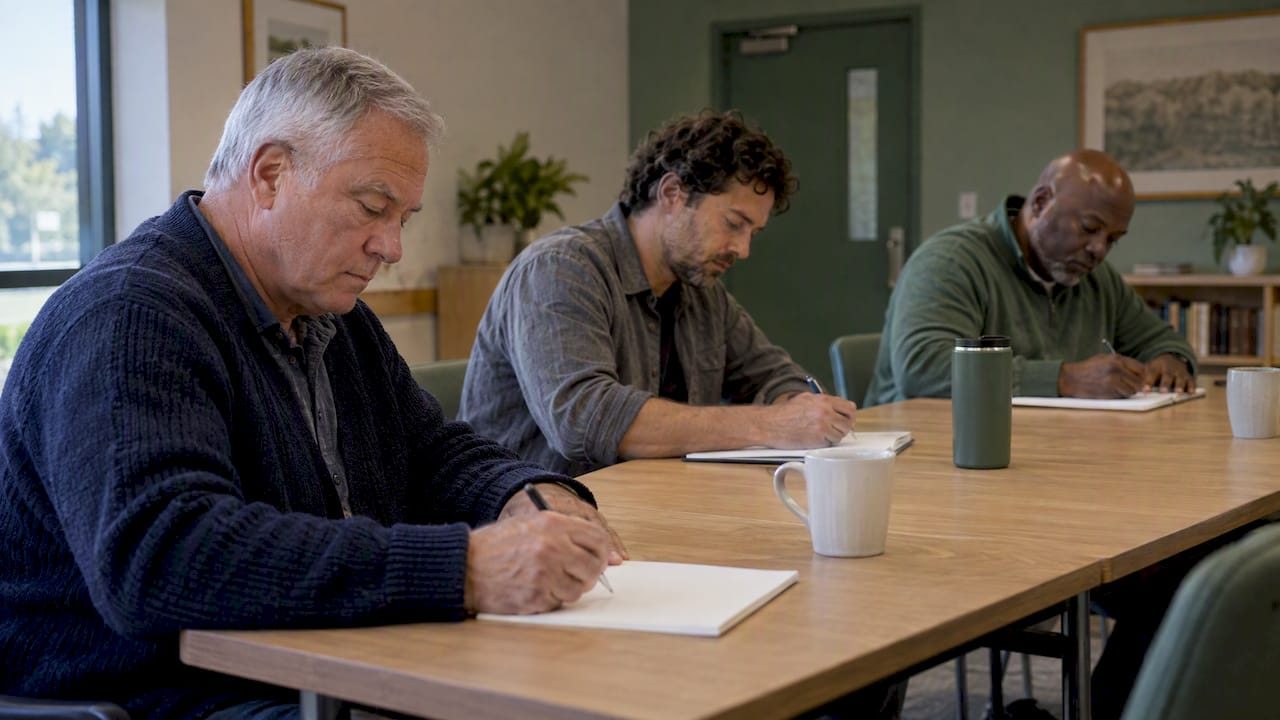
That same principle, low pressure and shared presence, shows up in many peer support formats for men, whether the setting is a formal group, a recurring meetup, or an informal circle of friends who check in on each other. What matters most is consistency and the absence of judgment, not a particular format or script.
For families creating a memorial page, this matters in a quiet way too. A shared memorial can function like a small peer space of its own, where contributors who knew him in different seasons of his life add their own pieces without needing to coordinate or perform grief in a particular way. One person might write two sentences. Another might upload a photo with no caption at all. Both are valid forms of participation, and both can sit comfortably on the same page.
How grief affects men’s health and when to seek help
Grief is not only emotional. It shows up physically too: disrupted sleep, appetite changes, fatigue that does not lift with rest, and a general sense of being unwell that can be hard to pin down. Left unaddressed, prolonged grief has been connected in clinical guidance to broader health strain, which is part of why checking in on physical well-being during mourning matters as much as checking in emotionally.
Mentally, grief can intensify into prolonged sadness, withdrawal from people and activities that used to matter, or a persistent numbness that does not ease with time. For some men, these feelings surface less as sadness and more as agitation, anger, or a short fuse with people they love. None of these reactions are unusual in the weeks and months after a loss, but a pattern that lasts for months without any lightening, or that includes thoughts of self-harm, is a signal to reach out to a doctor or a mental health professional rather than wait it out.
Writing and memorial-building are not substitutes for professional care when grief becomes this heavy. They are companions to it: something to do between appointments, or something to lean on while deciding whether professional support is the next right step.
Finding comfort beyond writing and memorial pages
Writing a tribute and building a memorial page can do real work in grief, but they are rarely the whole picture. Physical activity, shared meals, and time outdoors all give grief somewhere to move besides inward. Some men find that working with their hands, fixing something, building something, tending a garden, gives feelings a channel that conversation alone does not.
Shared activity with other people matters too, even when it has nothing to do with grief directly. A regular walk with a friend, a standing night at a card game, or simply showing up to something routine can rebuild a sense of connection without requiring anyone to talk about the loss at all. For older men in particular, maintaining these routines and support networks takes deliberate effort after a loss, and resources built around emotional wellness and support networks for older adults can help families think through what that looks like in practice.
Formal support groups remain valuable for men who want them, but they are one option among several, not the only path. The right combination is usually a mix: some structured support, some unstructured connection, and some quiet time alone with a project, a page, or a memory.
Encouraging men to speak openly about loss
Grief does not become easier to carry by staying unspoken. The stigma that tells men to grieve privately, quickly, and without visible struggle does not reflect how grief actually works, and it often leaves men carrying more weight alone than they need to.
Vulnerability is not the opposite of strength here. Writing one honest sentence about a father, a brother, or a friend takes a kind of courage that stoicism does not require. A memorial page built around real memories, including the hard ones, gives that courage somewhere to land, and it often gives other men permission to do the same when they read it.
Breaking that stigma rarely happens through a single conversation. It happens through small, repeated permissions: a workshop that says you do not have to share, a memorial page that welcomes an unpolished sentence, a friend who asks a second time after the first “I’m fine.” Each one chips away at the idea that silence is the only acceptable response to loss.
What families ask for and what actually works
Families creating a memorial often ask the same questions: how do we include his humor without making light of the loss, and how do we let distant relatives contribute without losing control of the page? We find that a curated music library organized by feeling and a printable program that pulls directly from the memorial tend to solve both at once, giving structure without flattening a man’s personality. There is no single correct way to remember him. The page simply needs to hold what was true.
— Memory Keep
Start a memorial page with Memory Keep
We built Memory Keep to make this process simple during a time when simplicity is hard to come by: a memorial page comes together in minutes, privacy settings stay in your hands, and family members can upload their own photos and stories without needing an account of their own.

A few small actions get a page moving today:
- Create a memorial page and add his name, dates, and a short bio.
- Upload three photos that show different sides of him.
- Copy the unique link or generate a QR code and share it with family.
Our Free plan covers the basics, and a one-time $15 upgrade on the Full plan unlocks unlimited photos, video, and storage with no subscription and no renewal. There are no ads and nothing is sold to third parties. If you are coordinating with a funeral home or celebrant, our resources for funeral professionals can help bring everyone onto the same page.
FAQ
What should I write in a short tribute for a man who has died?
Start with one specific memory rather than a general statement, since a detail like a habit, a phrase he used, or a shared moment tends to say more than broad praise. A tribute of 40 to 80 words works well for a memorial page or program, and it does not need to cover his whole life to feel complete.
How do I get a reluctant family member to contribute to a memorial page?
Keep the ask small: invite them to upload one photo or write two sentences rather than a full tribute. Workshop guidance for men writing through grief notes that removing any expectation to share publicly or write well makes people far more willing to participate at all.
Can an online memorial include humor and difficult memories, not just a polished story?
Yes, and memorial guidance recommends it. Stanford’s guide to memorials specifically encourages room for humor, ordinary stories, and complicated feelings rather than an idealized version of a life.
How much does it cost to create a memorial page with Memory Keep?
Our Free plan lets you start a page at no cost with limited uploads. A one-time $15 upgrade on the Full plan unlocks unlimited photos, video, and storage with no recurring fees.
When does grief become something that needs professional support?
If sadness, withdrawal, or physical symptoms like disrupted sleep persist for months without easing, or if thoughts of self-harm appear, it is time to talk with a doctor or a mental health professional. Writing and memorial-building can support that process, but they work alongside professional care rather than replacing it.
Sources
- A systematic writing program as a tool in the grief process: part 1 - PMC
- Poetry, Music, Flowers, and Everlasting Memories (Stanford guide)
- Fathers Writing Through Grief with Just Dads | Urban Arts Space