
Memorial Life Story: How to Write and Share One
A memorial life story is a fuller, warmer account of a person’s life than an obituary or a eulogy. It holds the places they came from, the people they loved, the habits that made them recognizable and a few stories only your family can tell. You can write it in an afternoon, gather it slowly with relatives, and keep it on a memorial page where everyone who loved them can read it, add to it and return to it. Memory Keep was built for exactly that: a permanent place for a life story, with photos, video and voices beside the words.
TL;DR
- A memorial life story is a written portrait of a life: character, relationships and stories, not only dates and survivors.
- Start with a timeline, add three to five specific stories, and let small details (a phrase, a dish, a daily walk) do the work.
- Ask family and friends for memories early. Their stories fill gaps you did not know existed.
- If you are not a writer, begin with one memory that starts with “I remember…” and build outward.
- Keep the finished story online on a page you can share by link or QR code, and let others add to it over time.
Table of Contents
- What a memorial life story is, and what it is not
- Before you write: gather the raw material
- What to put in a memorial life story
- If you are not a writer
- Writing a life story for a pet
- Sharing and keeping the story
- What a Memory Keep memorial adds to a life story
- Our perspective
- Frequently asked questions
- Sources
What a memorial life story is, and what it is not
People often search for a memorial life story when they have been asked to “say something” or to write “a few paragraphs for the program,” and they are not sure which form is wanted. The three common forms do different jobs.
- An obituary announces a death. It gives the basics: name, age, family members, service details. If you need that form, our guide to how to write an obituary walks through it.
- A eulogy is spoken. The Funeral Consumers Alliance of Connecticut describes eulogies as the remarks at a service that honor a life and mourn a passing, delivered by family, friends or colleagues.
- A memorial life story is written to be kept. It has room for context and texture: where someone grew up, what they lived through, who they loved, what made them laugh. It can be a page or ten pages, and it can grow.
The difference matters because each form has a different reader. An obituary is read once, quickly. A eulogy is heard once, in a room. A life story is read months and years later by a grandchild, a cousin overseas, or you, on a day when you need to hear that voice again.
Many families end up writing all three from the same material. Write the life story first, and the obituary and eulogy become short edits of it.
Before you write: gather the raw material
Grief makes memory unreliable. Details you were sure you would never forget slip away, and the person who knew the answer to your question may be the one you lost. So gather before you draft.
Build a simple timeline
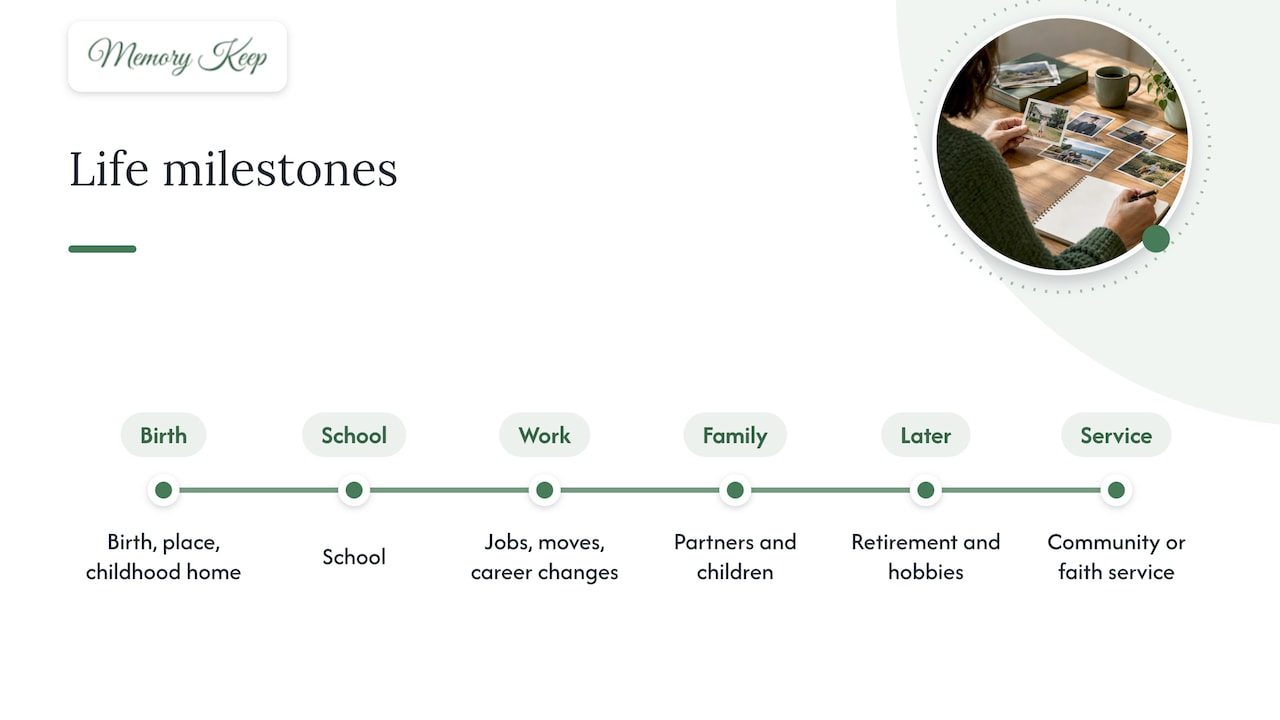
List the plain facts in order: birth and birthplace, childhood home, school, first job, moves, marriage or partnerships, children, career changes, retirement, hobbies, service to a community or faith. Do not worry about sentences. A bulleted list is enough.
A timeline gives you the skeleton, and it shows you where the gaps are. A missing decade is a good reason to call an aunt.
Collect photographs, documents and objects
Photographs are the best memory prompts there are. A picture of a kitchen can bring back the smell of a Sunday dinner. Gather old albums, phone photos, letters, recipe cards, military papers, report cards, ticket stubs. Scan or photograph them now, while you know where they are.
On a Memory Keep memorial page, photos, videos and audio can sit beside the written story, and the free plan lets you begin with limited uploads. The full plan removes the limits for that memorial, which helps when a family’s photo collection runs to hundreds of images. To see how families arrange these pages, you can look at a public example such as the memorial for Maurice J. Wizniak (1939–2026).

Ask the people who knew them
Your memories are one view. A brother, a coworker, a neighbor and a granddaughter each saw a different side. Oral history guidance from the Smithsonian Institution Archives suggests choosing an interviewee, setting a time and place, and building a chronology of key events with an outline of topics and follow-up questions before you sit down. That same discipline works well for family conversations.
A few practical habits from that kind of interviewing help:
- Decide who to ask and whether to talk one on one or in a group. One on one usually brings out more candid stories.
- Send a few questions ahead of time so people can think before the conversation.
- Bring a photograph or object. American Ancestors recommends asking about objects, photographs or documents from the past, then following up on what people say.
- Decide how you will save the answers. Record with permission, or take notes and read them back.
- Follow the tangents. The best story is often the one that begins with “Oh, that reminds me.”
If you want ready-made questions, our memorial story prompts give you a list to send to relatives or to answer yourself.
When the notes pile up, it can help to sort them by theme. A self-reflection tool such as the one at Life Audit Unfiltered uses ten life areas to prompt memories and organize life details, which some people find a useful way to notice what they have not yet written about.
What to put in a memorial life story
There is no single correct outline, but most strong life stories move through the same ground. Use the sections that fit, and skip the ones that do not.
| Section | What to include | Example of a useful detail |
|---|---|---|
| Who they were | Name, nickname, birthplace, family they came from | The name only their grandchildren used |
| Early years | Childhood home, school, early influences | The street where they played ball until dark |
| Work and service | Jobs, trades, volunteering, faith, military | The tool they kept for forty years |
| Relationships | Partner, children, friends, pets | How they met, in their own words if you have them |
| Character | Values, humor, quirks, what they stood for | A saying they repeated |
| Ordinary routines | Daily habits, favorite foods, places | A morning walk, the chair they always took |
| Stories | Three to five specific scenes | The time the car broke down on the way to the lake |
| What remains | What they taught, what they leave behind | A recipe, a garden, a way of treating people |
Let specifics carry the feeling
General praise (“she was kind and generous”) is true but slides past the reader. Specifics make the person appear. Guides on memorial biographies agree that concrete details land harder than adjectives: the way someone laughed, a dish they always brought, a favorite team, a book that was always on the nightstand.
A simple test: after each sentence of praise, ask “how did you see that?” Then write the answer. “He was generous” becomes “He never let anyone leave the house without a container of whatever he had cooked.”
Be honest and gentle at once
A life story does not need to be spotless. The Funeral Consumers Alliance of Connecticut notes that flaws and failures need not be ignored and can be presented with dignity. Someone who was stubborn can be remembered as stubborn, and the story can still be full of love. Readers trust a portrait that feels like a real person.
Include places and moments in time
A life happens somewhere. The towns they lived in, the ship they sailed on, the farm they left and the city they chose: these shape a story. Memory Keep memorials include interactive maps of life events, so the places in your timeline can appear on a map as well as in the text.
If you are not a writer
Most people who write a memorial life story are not writers, and that is fine. You do not need polish. You need a few true sentences.
Start small. Funeral.com suggests beginning with a single “I remember…” sentence about an image, a sound or a scene, rather than trying to summarize a whole life. Try one of these openings:
- I remember the sound of his truck in the driveway.
- I remember how she hummed while she cooked.
- I remember the first time he let me drive.
Write for ten minutes without stopping, then stop. Do the same tomorrow. After a few sittings you will have three or four scenes, and those scenes are the heart of the story. The timeline holds them together.
Some other habits make it easier:
- Write the way you would talk to a cousin who did not get to meet them.
- Use first names and nicknames the family actually used.
- Read it aloud. Wherever you stumble, simplify.
- Let someone else read it before you share it, ideally a person who also loved them.
Our longer guide on writing a life story for a memorial tribute goes through the drafting step by step, and the copy-ready tribute examples show a four-part structure you can borrow. Memory Keep also offers optional writing helpers and grief support resources, so you are not facing a blank page alone.
Writing a life story for a pet
A pet is family, and their story deserves the same care. A pet’s life story is often shorter and brighter, and writing it can be part of mourning.
VCA Animal Hospitals suggests including when the pet was born and joined the family, favorite toys and games, favorite sleeping spots, distinctive quirks or tricks, and the people or animals closest to the pet. They also describe recalling concrete facts and sharing stories as a way to highlight the animal’s significance and find comfort.
A few things to think about:
- The arrival story. How did the two of you meet? Was it a shelter, a farm, a box on the porch?
- The routines. The 6 a.m. breakfast request, the spot by the window, the sound of the leash.
- The personality. Was your dog dramatic, shy, a thief of socks?
- The people. Who loved them, and what did each person do with them?
For an example of a pet memorial page, see the memorial for Dixie (b. 2014).
Sharing and keeping the story
A life story written and then left in a drawer or a single email thread is easy to lose. The way you keep it matters as much as the way you write it.
VCA Animal Hospitals lists several ways to share and preserve a story: a photo journal with captions, a video journal made from photos and videos, social media, a blog, or a central site where friends and family can contribute photos and stories. The idea works for people as well as pets. The strongest option is the last one, because a central place keeps everything together and lets the story keep growing.
Here is what to look for in a place to keep a life story:
- It lasts. A story you cannot reach next year is not a memorial.
- It is private enough to feel safe. You decide who sees it.
- It is easy to share. A single link works for relatives in different countries.
- Others can add to it. Cousins have photos you have never seen.
- It does not charge you every year for keeping memories.
Memory Keep memorials meet each of these points. Each memorial has its own unique link and a free scannable QR code, which families can place on a headstone, a program or a card. Visitors can leave messages of remembrance, and family or friends can upload photos and videos to the same page. We do not run ads and we do not sell data.
What a Memory Keep memorial adds to a life story
A written story is one thread. A memorial page lets you weave in the rest.
Start free, with limited uploads and features, and write the story at your own pace. When you are ready for unlimited photos, video, audio and the full set of features, the Full plan is a one-time $15 payment for that memorial, with no subscription and no renewal. From the memorial you can generate a downloadable keepsake photo book and slideshow video, and printable programs and keepsakes are created from what you have already entered, so you do not have to type it all again for the service.
If a memorial is for two people, such as a couple, the joint memorial features let their stories sit together. A curated music library organized by feeling can help set the tone for a slideshow.

If you would like to begin today, you can create a memorial on Memory Keep and add the first paragraph while the memories are fresh. You can see everything included on the features page.
Our perspective
We believe a life story should be a place you can go back to, not a task you finish and file away. Grief arrives without warning, and so do memories. A story that can only be written once, in one sitting, asks too much of a family in mourning.
That is why we built Memory Keep around permanence and company. A memorial page is a home for the story, the photos, the voices and the messages friends leave, and everyone can add to it over time. A cousin can upload a photo from forty years ago. A friend can write the memory the family never knew.
We also believe keeping a memory should not become a bill that arrives every year. One payment per memorial unlocks unlimited photos, video and audio. There are no ads and no selling of your family’s information. Remembrance should be quiet and safe.
Whether the story is for a parent, a partner, a child or a beloved dog, the best life story begins with one true memory. We are here to help you keep the rest.
Memory Keep
Frequently asked questions
What is the difference between a memorial life story and an obituary?
An obituary is a short public notice of a death, with basic biography, family and service details. A memorial life story is a longer, personal account of who the person was, including their values, relationships and stories. Families often write the life story first and shorten it for the obituary.
How long should a memorial life story be?
There is no required length. Many families write between 400 and 1,000 words, enough for a timeline, a few stories and a closing thought. On a memorial page you can start short and add more later, so you are never committed to finishing in a single sitting.
Can I write a memorial life story for a pet?
Yes. Include when your pet joined the family, favorite toys and places, quirks and the people closest to them, as VCA Animal Hospitals suggests. Memory Keep supports memorials for pets as well as people, with photos, video and shared messages from friends and family.
Who should I ask for stories?
Ask relatives, longtime friends, coworkers, neighbors and anyone from a community or faith group the person belonged to. Each of them saw a different side. A few questions sent ahead of time, along with an old photograph, usually bring back the best stories.
How can family far away add to the story?
A memorial page has a unique link that you can send to relatives anywhere in the world. On Memory Keep, family and friends can upload photos and videos and leave messages of remembrance, so the story is shared rather than carried by one person.
Sources
- Lasting Words, Funeral Consumers Alliance of Connecticut
- How to Do Oral History, Smithsonian Institution Archives
- Conducting a Family History Interview, American Ancestors
- Writing prompts for someone who died, Funeral.com
- Memorializing Pets, VCA Animal Hospitals