
A good memorial page title honors the person, matches the tone of their life, and stays short enough to read at a glance. A classic choice is “In Memory of [Name],” a poetic one is “A Life Well Lived: [Name],” and for a beloved pet, “Forever Dixie” says everything. Below, you will find many more titles sorted by tone and category.
TL;DR:
- Keep the title to six to eight words or roughly 60 characters so it remains visible in page headers, browser tabs, and shared link previews.
- Use a full name for public tributes and a familiar nickname for family pages; omit dates if revealing a birth year would compromise privacy.
- Ask relatives whether finalists sound authentic; public pages suit classic titles, while private pages can use humor the person enjoyed with family approval.
- Keep any borrowed poem, lyric, or scripture to one short line, and name its source in the page subtitle when possible.
- Choose a trusted custodian to approve wording, manage permissions, and keep local copies because music and cloud media may have licensing limits.
Table of Contents
- Memorial page title ideas for every kind of tribute
- How to choose the right memorial page title
- Memorial title examples by tone
- A 10-minute exercise to write your own title
- Why a memorial page title matters
- Consulting family and moderating tone for public versus private pages
- Careful words, lasting access: our perspective
- Ready to give your title a home?
- FAQ
- Sources
Memorial page title ideas for every kind of tribute
Every family remembers differently, so we have grouped these titles by category. Pick one as written, or borrow its shape and swap in your own details. Each category begins with a note on when it fits best.
Short and classic. Use these when you want a title that works for every visitor, from close family to former coworkers. They rely on a name, a descriptor, and sometimes dates.
- In Memory of [Name]
- Remembering [Name]
- [Name]: A Life of Service
- Forever in Our Hearts: [Name]
- The Life and Legacy of [Name]
- Honoring [Name]
- [Name]: Beloved Always
- Celebrating the Life of [Name]
- In Loving Memory of [Name]
- Always Remembered: [Name]
Poetic and lyrical. Choose these when the person loved words, music, or quiet beauty. Short, evocative phrases work better than long quotations, which can crowd a page header and raise attribution questions.
- A Life Well Lived: [Name]
- Where the Light Stayed: [Name]
- Gone from Sight, Never from Heart
- [Name], Our Evening Star
- Still Here in Every Season
- The Song You Left Behind
- A Gentle Goodbye to [Name]
- Carried in Our Hearts: [Name]
- Until We Meet Again, [Name]
- The Warmth You Gave Us
Faith-based. These suit families whose loved one was devoted to a church, temple, or spiritual practice. Short scripture-inspired phrases are common, and when you borrow a specific verse, naming the source in the page subtitle is a kind and careful habit.
- At Peace in His Hands: [Name]
- Safe in the Light: [Name]
- Faithful to the End: [Name]
- Blessed Be the Memory of [Name]
- Walking in Grace: [Name]
- Rest in Peace, [Name]
- A Shepherd’s Heart: [Name]
- Called Home: [Name]
- Be Still and Rest: [Name]
- Held in Love: [Name]
- Finished the Race: [Name]
Career and role focused. These work well when someone’s work or community role shaped how others knew them: a teacher, a coach, a nurse, a volunteer. They also help colleagues and neighbors recognize the page right away.
- Coach, Mentor, Friend: [Name]
- [Name]: Teacher of a Thousand Lessons
- Serving Others: The Life of [Name]
- Captain [Name]: Duty and Honor
- Nurse, Neighbor, Friend: [Name]
- [Name]: Builder of Homes and Hope
- A Career of Kindness: [Name]
- Chef, Storyteller, Grandfather: [Name]
- [Name]: Our Community’s Quiet Hero
- Farmer, Father, Friend: [Name]
Celebratory and humorous. Use these only when the person themselves would have smiled at them. A light touch can feel like the most honest tribute, but when you are unsure, ask a sibling or an old friend how it lands.
- Celebrating the Life of [Name]: Bring Your Best Story
- [Name]: Laughed Loudest, Loved Hardest
- Well Played, [Name]
- Fishing in Heaven Now: [Name]
- [Name]: Life of the Party, Always
- The Legend of [Name]
- Thanks for the Laughs, [Name]
- One of a Kind: [Name]
Pet memorials. Affectionate, nickname-friendly titles are the norm here, because a pet’s name is often the whole story. If you are building a page for an animal companion, you may like our guide to living memorial ideas for people and pets.
- Forever Dixie
- Dixie: Our Loyal Companion
- Good Boy, Always: [Pet Name]
- [Pet Name]: Best Friend, Best Walks
- Paw Prints on Our Hearts
- [Pet Name], Gone Ahead to Wait for Us
- A Tail-Wagging Life: [Pet Name]
- Our Sunshine, [Pet Name]
- [Pet Name]: The Softest Goodbye
- Home Was Wherever [Pet Name] Was
Family-role titles. These put the relationship first, which helps relatives and friends feel the page speaks for them too.
- [Name]: Beloved Mother, Grandmother, Friend
- Dad, Husband, Hero: [Name]
- Our Brother, [Name]
- [Name]: The Heart of Our Family
- Grandpa [Name]: Storyteller and Safe Harbor
- A Daughter Remembered: [Name]
- Papa Joe: Forever Our Anchor
- [Name]: Sister, Confidant, Light
- Auntie [Name]: Everyone’s Favorite
- The Best Grandma We Could Ask For
How to choose the right memorial page title
Choosing is easier when you follow a short sequence of questions rather than staring at a blank field. Here is the order we suggest.
- Keep it brief. Aim for six to eight words, or under roughly 60 characters. Shorter titles fit a page header, a browser tab, and a social share preview without being cut off, and they are easier for visitors to remember and repeat.
- Match the tone to the person. Think about who they were at their warmest. A quiet gardener and a loud, joke-telling uncle call for different words, and visitors will sense when a title rings true.
- Decide how to use their name. A full name suits a public tribute, while a nickname feels warmer for a family page. Dates add clarity but also reveal a birth year, so leave them out if privacy matters to you.
- Quote with care. If you borrow from a poem, lyric, or scripture, keep it to a single short line and name the source when you can. The advice we see for memorial and obituary titles often points to poems, quotes, or scriptures as inspiration, always with the goal of capturing who the person truly was. For more ready phrases, our collection of meaningful memorial quotes can help.
- Name a content custodian. Choose one trusted person to approve the title, manage permissions, and keep copies of what is shared. Appointing a content custodian matters because purchased music and cloud-stored media often carry licensing limits that complicate perpetual ownership.
Pro Tip: Type your title into the page header, then check how it looks as a link preview in a message to yourself. If it gets cut off, trim a word.
Memorial title examples by tone
Here are handpicked titles with a short note on why each tone fits. Read them aloud. The right one usually feels like the person’s own voice.
Solemn. These suit formal, public memorials, such as a veteran, a public servant, or a respected elder.
- In Solemn Remembrance: [Name]
- With Deepest Respect: [Name]
- A Life of Quiet Dignity
- Honor and Remembrance: [Name]
- The Memory of [Name] Endures
- In Sorrow and Gratitude: [Name]
- Gone but Never Forgotten
- A Final Salute to [Name]
Uplifting and celebratory. These suit life-celebration pages where the goal is gratitude rather than grief alone. Our ideas for creative ways to honor a loved one pair well with this tone.
- Celebrating a Life of Joy: [Name]
- Thank You for Everything, [Name]
- A Life Full of Color: [Name]
- Dancing On: [Name]
- [Name]: A Bright Spirit
- Grateful for [Name]
- The Best Chapters of [Name]'s Story
- Sunshine Remembered: [Name]
Humorous and irreverent. Use only when the person preferred this tone and the family agrees.
- Told You I Was Sick: [Name]
- [Name] Has Left the Building
- Still Telling the Same Jokes
- The Last Word Goes to [Name]
- Save Me a Seat: [Name]
- No Regrets, Plenty of Stories
Poetic and lyrical. These adapt familiar feelings into short titles that avoid long quotation.
- Soft Light, Long Shadows: [Name]
- A Quiet Kind of Brave
- You Are the Morning We Remember
- Roots and Wings: [Name]
- Where Memory Keeps You
- The Tide Brings You Back
Faith-based. Short spiritual phrases work well. If a title echoes scripture closely, cite the verse in the page description.
- Peace Be with You: [Name]
- Rejoicing in Heaven: [Name]
- In God’s Garden: [Name]
- Forever in His Care: [Name]
- Light Everlasting: [Name]
- Praise for a Faithful Life
Pet memorials. Nicknames and affectionate phrases make these titles feel personal.
- Forever Our Good Girl: [Pet Name]
- Run Free, [Pet Name]
- Muddy Paws, Golden Heart
- [Pet Name]: Cat Naps and Quiet Love
- Our Little Shadow: [Pet Name]
- Best Boy, Always
If your title will sit beside a slideshow, the music matters as much as the words. The most effective slideshow songs reflect the person’s era and taste, and slow-to-moderate tempos give each photo time to be seen.
Tempo shapes how long visitors stay with a gallery: music and slideshow tempo should reflect the person’s character and era, because tempo influences emotional tone and engagement. Choose a title and a soundtrack that sound like the same person.
A 10-minute exercise to write your own title
If none of the examples fit, build your own. Start with one of these prompts and fill in the blanks.
- Name plus trait: “[Name], the one who always ______.”
- Memory plus feeling: “Sunday mornings with [Name]: ______.”
- Role plus adjective: “[Name], our ______ [role].”
Then run your draft through this checklist:
- Tone: Does it sound like them?
- Length: Is it under about 60 characters?
- Name use: Is the name or nickname the one visitors will recognize?
- Audience: Will every likely visitor feel welcome?
- Sharing and privacy: Are you comfortable with this wording, and any dates, appearing in a link preview?
Here is one way to try it. Take the prompt “[Name], the one who always ______.” Fill in “had a pot of coffee on,” and you get “Maria, the One Who Always Had the Coffee On.” The tone is warm, the name is clear, and the whole line is short. Trim it to “Maria: Coffee Always On,” and you have a title her family would smile at.
Why a memorial page title matters
A title is the first thing a visitor reads and often the only thing someone sees in a shared link. In a few words, it tells people what kind of place they have arrived at: a formal remembrance, a warm celebration, a family gathering of stories.
That first impression sets the emotional tone for everything below it, including photos, tributes, and messages. A gentle, well-chosen title invites visitors to slow down, and it gives grieving family members the feeling that their person has been named with care.
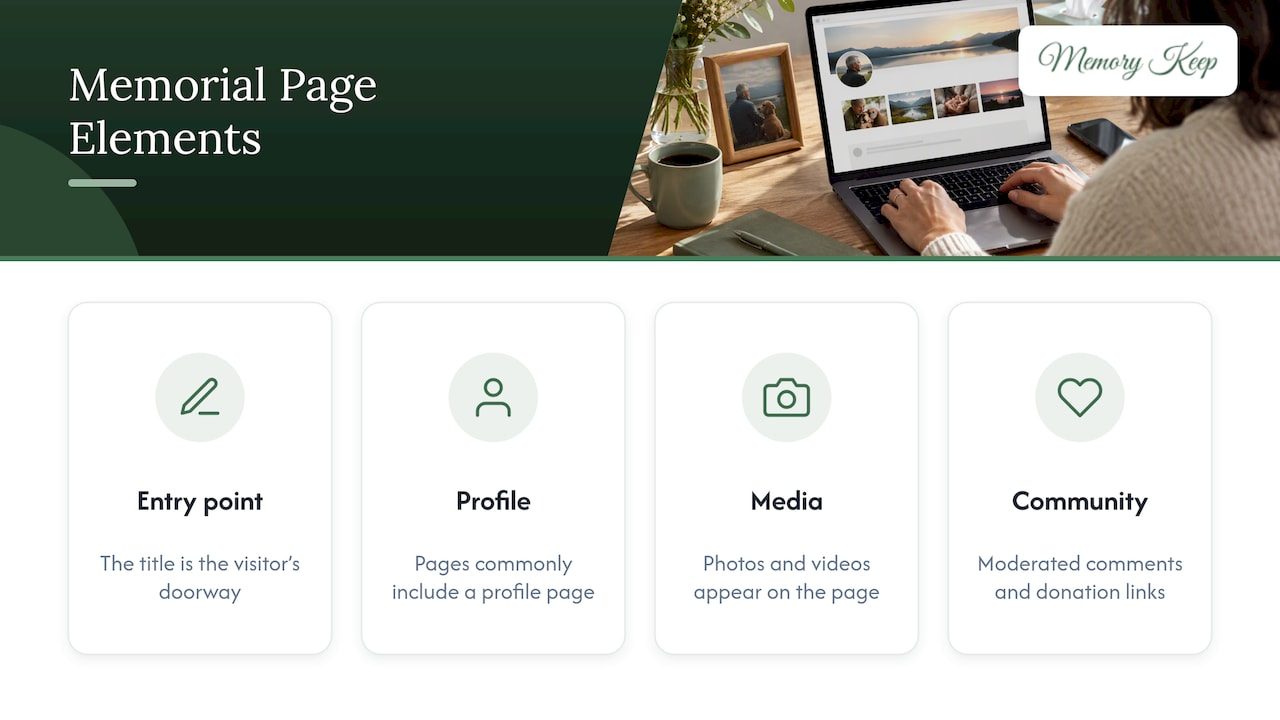
Online memorial pages commonly include a profile page, photos and videos, moderated comments, and links to donations, and the title is the doorway into all of it. It also quietly signals who the page is for. A title built around a nickname welcomes close friends, while one built around a full name and a role welcomes colleagues and the wider community. Because you will see it every time you return, choose words you will still be glad to read in a year.
Consulting family and moderating tone for public versus private pages
A memorial page rarely belongs to one person. Siblings, spouses, children, and old friends may each remember someone differently, so a quick conversation before you publish can save hurt feelings later.
Share two or three finalists and ask a simple question: “Does this sound like them?” You do not need agreement on every word, but you will often learn a detail, such as a nickname only the grandchildren used, that makes the title better.
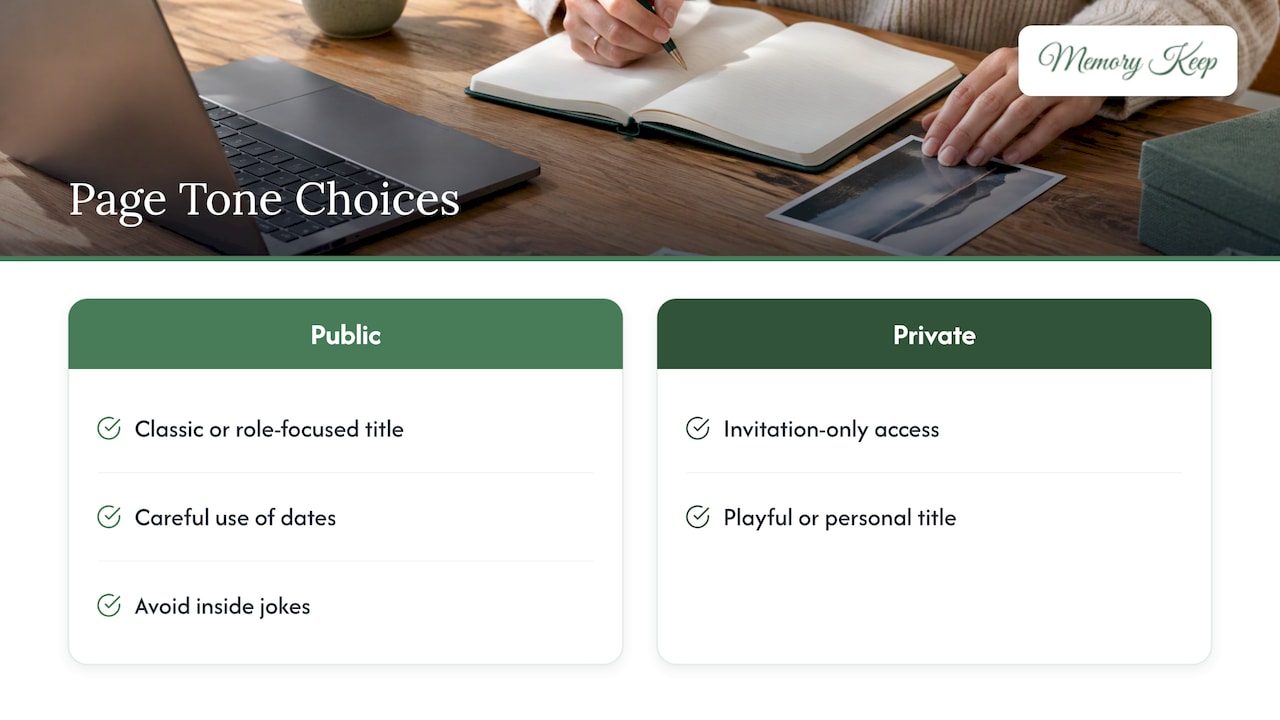
Public and private pages call for different choices. A page shared widely with the community leans toward a classic or role-focused title, with careful use of dates and no inside jokes that strangers would not understand. A private, invitation-only page can be as playful or personal as the family likes. If the page allows visitor messages, think about moderating comments, too, so the tone you set in the title carries through the whole page. Our overview of the benefits of creating and sharing an online memorial explains how sharing settings fit with these decisions.
Careful words, lasting access: our perspective
Careful wording does two things at once: it honors the person today, and it helps visitors years from now understand who they were. We believe the title is worth a few quiet minutes of thought.
We also encourage every family to appoint a content custodian, someone who looks after permissions, media licensing, and local copies over time. Our guide to memorial page content elements is a good next step.
— Memory Keep
Ready to give your title a home?
Once you have a title you love, we make it simple to turn it into a lasting page. Each memorial has its own shareable link, room for photos, videos, and tributes, and an upgrade option for additional features. You can see what is included on our pricing page, or read the title and tribute of a finished memorial to see how families put it all together, such as Dixie’s page. When you are ready, you can start your memorial today and save your title as the first thing visitors see.
FAQ
How to celebrate a deceased person’s birthday?
Many families light a candle, share a favorite story, or visit a place that mattered to the person. On a memorial page, you can post a new photo or a short message each year, so relatives near and far can take part.
What are some good quotes to put on memorial plaques?
Short lines work best on plaques, since space is limited and the words should read clearly at a glance. Poems, scriptures, and a favorite saying of the person are all common sources, and our memorial quotes collection offers many options.
How to make a memorial website?
Start by choosing a title and gathering a handful of photos and a few written memories. Then add them to a memorial page, set who can view and contribute, and share the link with family and friends.
What do you call a memorial service brochure?
It is most often called a funeral program or order of service. It typically lists the schedule, readings, music, and a short tribute to the person.
Sources
- Memorials
- Death and the Internet: Consumer issues for planning and managing digital legacies (2nd edition)
- Cremation-ca
- Memorial Slideshow Songs: 60 Hand-Picked Tracks to Build a…
- Quickfuneral