
Online Memorial Etiquette: What to Say, Share and Avoid
Online memorial etiquette comes down to one idea: bring the same care you would bring to a funeral home, and let the family lead. Ask before you share, write real words instead of reactions, keep your message warm and brief, and leave out anything that would hurt the people who loved the person or pet most. If you are the one creating a memorial, you set the tone for everyone who visits, and a few simple choices make that space feel safe.
Grief arrives without warning, and it often arrives on a screen: a post, a text, a link in your inbox. Many of us do not know what is kind to write, whether we may forward a link, or how to behave at a service we attend from a laptop. This guide walks through those moments gently, for visitors, for the family, and for anyone who loves an animal as much as a person.
TL;DR
- Check with the closest family before you post news of a death, share a service, or forward a memorial link.
- Write words, not emojis. A short, personal memory is worth more than a perfect phrase.
- At a virtual service, arrive early, mute yourself, dress as you would in person, and keep chat messages supportive.
- Leave out the cause of death, family conflict, jokes and private stories in public tributes.
- A memorial page you create can set the tone from the start, so decide who may see it and how you would like people to contribute.
Table of Contents
- Why online memorials need their own etiquette
- Before you post: ask the family first
- What to write in a condolence message or tribute
- Attending a virtual funeral or memorial service
- Sharing a memorial link and photos with care
- When children are reading
- Memorials for pets
- If you are not sure: a quick check
- Etiquette when you create the memorial
- A place that keeps etiquette simple
- Our perspective
- FAQ
- Sources
Why online memorials need their own etiquette
A printed guest book sits on a table in a room full of people who know one another. An online guest book is open to anyone with the link. That difference is the reason etiquette matters here.
The problem is not new. In 2006, The New York Times reported that one large obituary site employed 45 screeners to review 18,000 guestbook notes a day, watching for backhanded compliments, mean-spirited remarks and airings of family secrets. Online, a stranger or an estranged relative can write beside a grieving child. The family usually sees every word.
There is a gentler side too. A memorial page can grow over weeks, months and years as people add stories they remember. That only works when visitors feel welcome and the family feels protected. Good manners are what make both true.
Before you post: ask the family first
The most common mistake is also the easiest to avoid: announcing a death or sharing service details before the family is ready.
Grief researcher Carla Sofka’s netiquette guide from Siena University says you should not share information about services or memorial events on social media without permission from the family or primary mourners. It also says you should never livestream a funeral without explicit permission from the primary mourners and anyone with a primary role in the service. The same guide suggests timing a digital obituary with the funeral director, because once something is online, control over how it spreads is gone.
In practice:
- Wait to be told. If you heard about a death secondhand, do not be the first to post it. Family members may still be calling relatives.
- Ask a close person. A short call or text, such as “Would you like me to share the memorial link, or would you rather keep it private?” is enough.
- Soften the news. The Siena guide recommends a brief note that the post contains sad news, so no one meets it unprepared.
- Do not repost services or links on your own. A memorial link sent to you is an invitation to you. Forward it only if the family has said that is welcome.
If you are not sure, wait. A post can go up tomorrow, but it cannot be taken back from the people who already saw it.
What to write in a condolence message or tribute
Most people freeze at the blank box. The good news is that the bar is low and the kindness is simple.
Use words, and keep them yours
AARP’s 2026 guide to digital condolences, with etiquette authority Lizzie Post, advises against relying on emojis or reactions in place of words like “I’m so sorry for your loss.” It also says the closer you are to the person, the more you should use a personal channel one step above your usual way of reaching them. A distant coworker might leave a comment. A best friend might call or send a voice message.
Share a memory
Bustle quotes Sarah Jones, director of Full Circle Funerals, saying that a great sympathy message shares a memory and how it makes you feel. She adds that if no words feel enough, you should still send something, because the family wants to know you care. She also notes that many families love hearing new stories, because the stories keep them connected to the person.
Here are a few shapes a good message can take:
- A small, specific memory: “I’ll always remember how Margaret saved me a seat at every church supper and asked about my kids by name.”
- What they meant to you: “Dan taught me to fish when I was nine. I still hear his voice every time I’m on the water.”
- For a pet: “Biscuit greeted every single person at our door like they were the best part of his day. We loved him too.”
- When words fail: “I don’t have the right words, but I’m thinking of you and I’m so sorry.”
What to leave out of a public message
A funeral home’s death etiquette guide suggests being a little more formal than usual online, avoiding bawdy or private stories in public, not asking about how someone died, verifying facts before posting, and remembering that children may read what you write. A guestbook guide adds a few more things that rarely belong in a memorial message: complaints about how the funeral is being handled, offensive language, mentions of inheritance, and religious messages when you do not know the family’s faith.
Put simply, skip these in a public tribute:
- The cause of death or medical details
- Old arguments, family conflict or “unfinished business”
- Jokes or sarcasm that only a few people will understand
- Anything that could embarrass the person or the family
- Generic lines you could paste on any page, like “Rest in peace” with nothing else
It is also never too late. The same funeral home guide says it is still fine to comment on a memorial post weeks after a death. Grief does not end at the service, and a message in month three can mean the most.
Offer help, not just sympathy
AARP’s guidance recommends offering specific help the family can accept or decline with a simple yes or no. “Can I drop off dinner Thursday?” is easier to answer than “Let me know if you need anything.”
Attending a virtual funeral or memorial service
More services now include a livestream for relatives who live far away. Online attendance is still attendance, and the people on the other end can see and hear you.
WIRED’s 2021 guide to virtual funeral etiquette gives a clear routine, and other funeral homes echo it:
- Prepare early. Download the platform ahead of time, test your camera and microphone, and log in five to ten minutes early.
- Dress as you would in person. Somber colors, no pajamas or hoodies.
- Minimize distractions. Close other programs, turn off notifications and silence your phone. Choose a quiet spot with a tidy background.
- Mute yourself unless you are asked to speak. The host manages who speaks.
- Keep your camera on if you can, so the family can see who is with them. WIRED, drawing on etiquette expert Elaine Swann, notes that if you cannot do that, you might consider sitting the service out.
On chat, a funeral service’s digital etiquette rules suggest posting short sympathy comments such as “We are here with you” before the service begins, so they do not pull attention during it, and avoiding sarcasm and jokes in anything you type. Another funeral home’s livestream tips add that chat is best kept to supporting the family or sharing stories about the person.
If you are invited to speak, keep your words brief, heartfelt and centered on the person you are remembering.
After the service, keep going. A call, a card or a note on the memorial page tells the family you are still thinking of them when the crowd has gone home.
Sharing a memorial link and photos with care
A memorial link is an invitation, and the person who owns it decides who receives it.
If you are a visitor:
- Treat the link as meant for you. Ask before sending it to others, especially to coworkers, acquaintances or public groups.
- Before you post a photo of the person on social media, think about who is in the picture and whether they would want to be seen. Tagging the person who has died can place the photo in other people’s feeds, a point the Siena guide raises, and some find that painful.
- Never ask to change or close the deceased person’s accounts unless you have been named to act for them. The Siena guide is firm on this.
If you are the family:
You can decide, before anyone visits, who the page is for. Some families share a link only with a small circle. Others want a wider group of friends, coworkers and neighbors to leave notes. Either choice is fine. What helps is telling people which it is. Our guide on how to invite guests to an online memorial page walks through wording for the invitation itself.
It can also help to say, in a line near the top of the page or in your invitation, what kind of messages you would love to see: favorite stories, photos from trips, a recipe they made. That gentle guidance tends to shape everything that follows.

Some families also choose to set a simple standard for comments and ask one trusted person to watch over them. A funeral industry resource suggests families decide ahead of time what will not be welcome, such as speculation about the cause of death, graphic details, family conflict or anything involving minors. You do not need to be harsh about it. A kind, clear note at the start goes a long way.
When children are reading
Children may see memorial pages, comments and photos, sometimes before the adults have found the right words. The funeral home guide mentioned above reminds writers to remember that children might read what is posted. If a child in your family is grieving, it is worth reading the page together first and choosing what they see. This guide on helping a child grieve offers ideas on what to say, do and read together.
Memorials for pets
Pet loss is real loss. Many people feel they must apologize for how deeply it hurts. They do not need to, and neither do you when you write on someone else’s pet memorial.
The same rules apply, with a warm twist:
- Take the loss seriously. Skip phrases like “it was just a dog.” Say the pet’s name.
- Share a specific memory, such as the sunny spot on the porch, the toy they carried everywhere, or the way they waited at the window.
- Include the whole circle. Neighbors, pet sitters, groomers and veterinary staff often loved the animal too, and a family may be glad to invite them.
- Do not ask how the pet died or whether the family “could have done something.” Guilt is already heavy.
A pet memorial is a place for gratitude. Short notes, photos and stories are just right.
If you are not sure: a quick check
The National Bereavement Service in the United Kingdom suggests a few questions to ask before you post: would anyone be offended, is it respectful to the person, and would you want to read it yourself. It also recommends checking with close family first.
Here is a version you can keep in mind:
| Question | If the answer is no or unsure |
|---|---|
| Has the family said they are ready for this to be shared? | Wait, or ask a close relative |
| Would the family be glad to read it? | Rewrite it, or send it privately |
| Is it kind, true and about the person? | Remove the detail you are unsure of |
| Would it be fine if a child read it? | Keep it for a private conversation |
| Is a call or note more fitting for how close you are? | Reach out personally |
When in doubt, send the message privately. A private message can never be the wrong call.
Etiquette when you create the memorial
If you are the one building a page, you are the host. Visitors take their cues from you.
- Start with the person, not the loss. Open with a favorite photo and a few lines about who they were.
- Say who the page is for. A short welcome sentence helps visitors know whether it is open to all friends or a private circle.
- Invite stories. Memory Keep memorials allow collaborative uploads by family and friends, so cousins, old classmates and neighbors can add photos and videos you might never have seen.
- Share thoughtfully. Each memorial has a unique link, and you can print a QR code for a headstone or a card.
- Plan ahead if you can. Some people prefer to decide on music, photos and privacy before a loss, and our guide to pre-planning an online memorial shows how.
If you need more ideas for what to include, online remembrance ideas offers low-cost ways to honor someone. And if you or a relative are grieving and need more than a page, our grief resources collect places to turn for support.
A place that keeps etiquette simple
Memory Keep is an online memorial platform for people and pets. Families preserve photos, videos and tributes on a page with its own link, and visitors can leave messages of remembrance. The Free plan lets you begin with limited uploads and features. The Full plan is a one-time $15 payment for a memorial, with no subscription or renewal. We do not run ads or sell data, which matters when a page holds a family’s most personal moments.
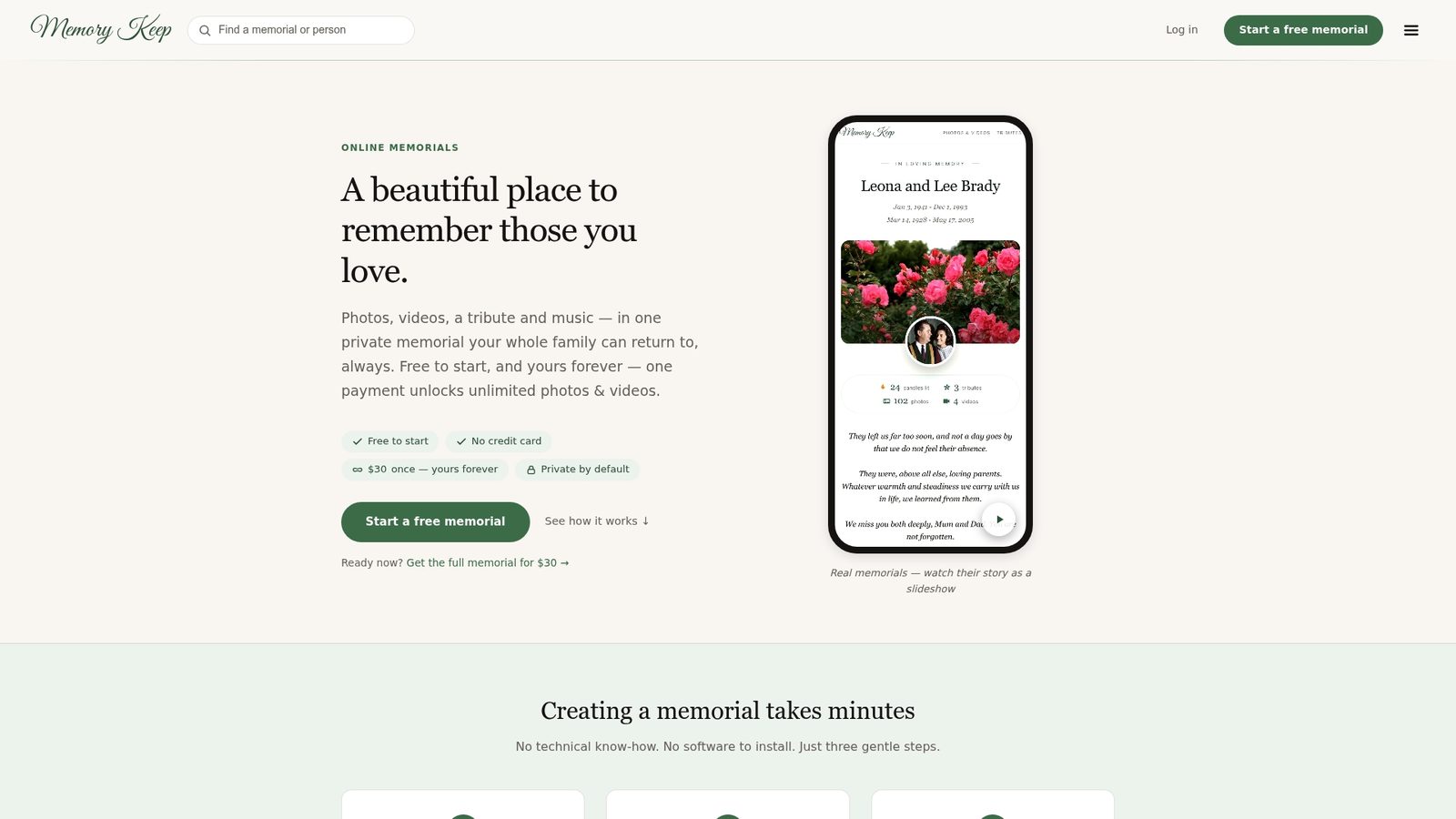
If you would like to see what a memorial can hold, from interactive life maps to a curated music library organized by feeling, you can look through our features or begin a memorial when you are ready. There is no rush. Grief keeps its own time.
Our perspective
We believe etiquette is really just love with a little structure. People want to say the right thing, and most worry they will say the wrong one. So they stay silent, and a family that is hurting hears nothing.
We built Memory Keep so that remembering does not depend on getting every word perfect. A memorial page gives everyone a shared, lasting place to bring a photo, a story or a short note, so that the family does not have to chase messages across texts, posts and cards.
We also believe that a family’s privacy is part of its comfort. That is why we do not run ads or sell data, and why a memorial belongs to the people who love the person or pet it honors. Every memorial has a unique link you can share as widely or as narrowly as you wish, and the one-time payment means a page is not something you have to keep paying to preserve.
To anyone unsure what to write: tell the family you are thinking of them, share one true memory, and say the person’s name. That is enough. It is almost always more than enough.
Memory Keep
FAQ
Is it okay to post about a death on social media before the family does?
It is kinder to wait. Bereavement and etiquette guides, including the Siena University netiquette guide, advise getting permission from close family before sharing news, service details or a livestream. If you are unsure, call a close relative or send a private message instead.
What should I write on someone’s online memorial if I did not know them well?
Keep it short and sincere. Say you are sorry for their loss, and if you have one, share a brief, specific memory or what you admired. Use words rather than emojis, and avoid questions about how the person died.
Can I still leave a message weeks or months after the loss?
Yes. One funeral home guide notes it is still fine to comment on a memorial post weeks after a death. Many families find later messages especially comforting, because the rest of the world has moved on and yours shows you remember.
How early should I join a virtual funeral, and should my camera be on?
Log in five to ten minutes early to test your sound and video. WIRED’s etiquette guide suggests keeping your camera on if you can, so the family can see who is there, and keeping your microphone muted until you are asked to speak.
Do the same rules apply to a pet memorial?
They do. Treat the loss with the same seriousness, use the pet’s name, and share a specific memory. Avoid asking what happened or whether the family could have done something differently.
Sources
- In Online Mourning, Don’t Speak Ill of the Dead, The New York Times
- Netiquette Regarding Digital Legacies and Dealing with Grief, Siena University
- A Guide to Sending Condolences in Our Digital Age, AARP
- What To Write In A Sympathy Card When There Are No Words, Bustle
- Death Etiquette and Social Media, Phaneuf
- A Guide to Virtual Funeral Etiquette, WIRED
- Expressing Sympathies at a Virtual Funeral: Seven Essential Rules of Digital Etiquette, Vaughn C. Greene Funeral Service
- Funeral Etiquette Tips for Livestream Services, Buch Funeral Home
- Posting about Death on Social Media, National Bereavement Service
- Helping a Child Grieve: What to Say, Do and Read Together