

Transferring Memorial Ownership: Pages, Plots and Listings
When someone searches for how to transfer memorial ownership, they usually mean one of three different things: an online memorial page, a cemetery plot, or a listing on a public grave database. Each has its own rules and its own person to ask. The common thread is that the right hands should hold the memorial, and the earlier a family decides who those hands are, the gentler the handover will be. We wrote this guide for families in the middle of loss, so we take each kind in turn and keep the steps plain.
TL;DR
- Online memorial page: ownership means who can edit it and invite others. Agree on one trusted family member as keeper, and write down who comes next.
- Cemetery plot: you almost never own the land. You hold a right of interment, and the cemetery must approve and record any transfer in writing.
- Public grave listings: a transfer usually starts with a request to the current manager, explaining your relationship to the person who died.
- Memory Keep: a memorial is a permanent page with a one-time upgrade and a share link, so a family can plan its keeper from the start. Our help page is the place for questions about your own memorial.
Table of Contents
- Three Things People Mean by “Memorial Ownership”
- Online Memorial Pages: Ownership Is About Care
- Cemetery Plots: You Hold a Right, Not the Land
- Public Grave Listings: Asking the Current Manager
- Why a Family-Held Memorial Is Easier to Hand Over
- What We Believe About Keeping a Memorial
- Start a Memorial You Can Share and Hand On
- A Short Checklist for Any Kind of Handover
- FAQ
- Sources
Three Things People Mean by “Memorial Ownership”
Grief arrives without warning, and so do the practical questions that follow it. A sister has been tending a page for your father, and now you wonder whether it should be in your name. A cemetery plot was bought by a grandparent who has since died. A stranger created a listing for your great-aunt years ago and has never answered a message.
These are three separate situations:
- An online memorial page, where “owner” means the person who controls what appears and who may add to it.
- A cemetery plot, where “owner” is a legal shorthand for the person who holds the right to bury someone there.
- A public grave listing, where a volunteer or relative created a page, and the question is who manages it.
The sections below follow that order, starting with the one closest to what we do.
Online Memorial Pages: Ownership Is About Care
An online memorial is not a deed. No court registers it, and no cemetery signs off. What matters is who can shape the page: the photos, the tribute, the music, the invitations to family and friends. That makes the question less legal and more personal, and it is worth answering while everyone is still gathered and willing to talk.
Decide who the keeper is
Most families have one person who naturally takes on the work: the spouse, the eldest child, the sibling who lives closest. Ask them directly, and ask whether they want the role. Grief work is heavy, and some people would rather contribute than carry the page.
A good keeper does three things:
- keeps the sign-in details safe and shares them with no one casually,
- welcomes contributions from relatives and friends,
- watches the visitor messages so the page stays a kind place.
If comments are a worry, our guide to keeping tribute comments kind walks through a gentle routine.
Name a second person
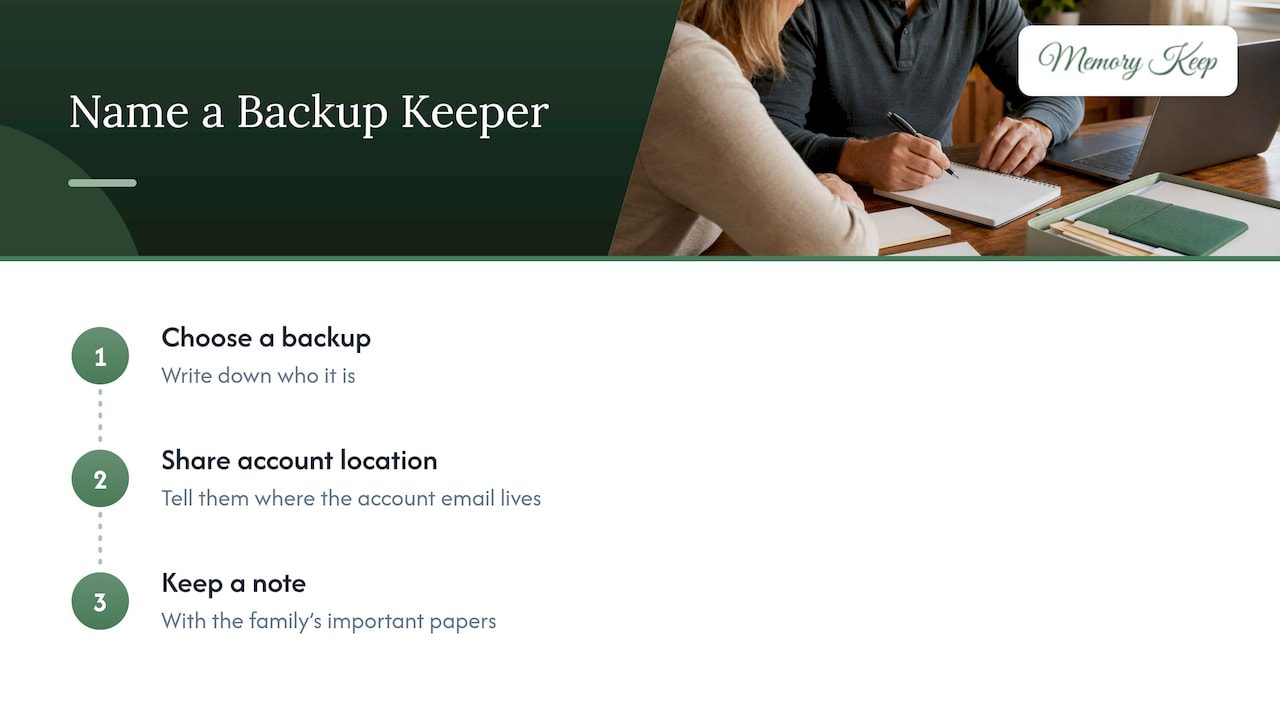
The most common reason a memorial becomes hard to hand over is that only one person ever knew how to reach it. Write down who the backup is. Tell them where the account email lives. A short note kept with the family’s important papers is enough.
This matters most for pets as well as for people. A memorial for a dog or cat is often managed by one household member, and when a child grows up and moves out, the question of who holds it can arrive quietly. If you are building a page for a companion, our pet memorial pages are made for exactly this.
Let many hands add, one hand keep
With Memory Keep, family and friends can upload their own photos and videos to a memorial, and visitors can leave messages of remembrance. That means a page does not depend on a single person’s camera roll. Cousins can add the picture from the lake house; a former coworker can leave a story. The keeper’s role becomes hosting rather than carrying everything alone.
Before you add someone else’s photo, it helps to know who can say yes to using it. Our piece on photo permission for a memorial explains this in plain terms.
Contributed photos can also become something you hold in your hands. If a family wants a framed print of a favorite picture, canvas versus acrylic memorial prints shows how each finish handles glare and texture.
When the keeper changes
People step back for many reasons: illness, distance, their own grief. If your family needs to change who looks after a Memory Keep memorial, start with our help page and tell us which memorial it is and what has changed. We will point you to the right next step for your page.
Cemetery Plots: You Hold a Right, Not the Land
This is the meaning behind most searches that mention “transferring grave ownership,” and it surprises many families. Buying a plot is rarely like buying a lot of land. Oakwood Cemetery in Berlin, Wisconsin, states in its rules approved in October 2025 that no person “owns” a grave: purchasers buy an easement, which is the right to bury someone in that space. The cemetery remains in charge of the ground.
That is why the cemetery, and not the family alone, decides how a transfer happens.
What cemeteries generally require
Rules differ from one cemetery and state to the next, but the published rules of several cemeteries show a clear pattern:
| Cemetery | What its published rules say |
|---|---|
| Cypress Lawn Memorial Park (2025) | A transfer of an interment right is valid only if the cemetery approves it and records it. Consent may be withheld if money is owed on the purchase, transfer or assignment. |
| Pine Lawn (2020) | A transfer is not effective until it is approved and recorded and any fee is paid. Only the original owner may transfer; if that person has died, next of kin share the rights equally. |
| Town of Ipswich, Massachusetts (2023) | Transfers are arranged through the Cemetery Department, private resale is not allowed, and a $25 fee covers deed research and processing of a new deed. |
| Oakwood Cemetery, Berlin, Wisconsin (2025) | Transfers outside the family go through the City Clerk’s office by quitclaim deed, which may be recorded with the Register of Deeds. |
The lesson is consistent. A handwritten note between relatives, or a private sale the cemetery never records, will not be honored when someone needs the space.
A practical path for a plot
- Find the original paperwork. Look for the deed, certificate or contract. It names the owner and describes the space.
- Call the cemetery office. Ask for its written transfer requirements and the form it uses. Cemeteries can differ on whether they use a transfer form, an assignment of burial rights or a deed.
- Confirm who may transfer. If the original owner has died, you may need proof of the relationship, and the rules may say the rights pass to next of kin together.
- Complete and sign the cemetery’s form, and pay any transfer fee.
- Ask for the updated record. The right is effective once the cemetery has recorded it, so request written confirmation.
- Check for county recording. In North Carolina, for example, a Pierce Law explanation notes that if the transaction conveys an interest in land, N.C. Gen. Stat. § 47-18(a) calls for registration with the county Register of Deeds. Other states differ.
Plots and inheritance
When the owner has died, the plot is part of what the family must sort out together. State rules vary, so a family with several heirs, an unclear will or a disagreement should speak with an estate attorney in their own state, and with the cemetery, before signing anything. If a single plot is wanted by more than one person, the cemetery’s records and the state’s rules decide, not who has been tending the grave.
Public Grave Listings: Asking the Current Manager
Large public databases let volunteers create a page for a burial and then manage it. If a relative of yours is listed and the manager is someone you do not know, the usual route is to use the page’s suggest-an-edit option, explain your relationship to the person who died, and ask for the page to be transferred. These sites commonly limit transfers to close relatives, often defined as direct family within a set number of generations, and they usually do not require a distant relative to be granted one.
A few practical points help every time:
- Ask kindly and be specific. Say how you are related and why you would like to care for the page. A courteous note is the most likely to get a reply.
- Ask whether you need a transfer at all. Often you can add photos or suggest corrections without becoming manager, which is simpler for everyone.
- Allow time. Managers are volunteers. If weeks pass with no reply, the site’s own support team is the next place to write.
- Expect limits. Managing a page typically lets you edit the information, but images posted by other people may only be removable by the person who posted them.
The policies on these sites change, so read the site’s current help pages before you write.
If a page has been removed
Sometimes a listing disappears. The reason is usually a duplicate page, a merged record or a policy issue. Ask the site’s support team what happened, give the full name and the dates, and describe your relationship. Keep a copy of the photos and text you have, so nothing is lost while you wait.
Why a Family-Held Memorial Is Easier to Hand Over
A public listing may be created by someone who never met your loved one. A cemetery plot is bound by rules that predate you. A memorial your family builds yourselves is the one place where the story is told in your words, and the keeper is whoever the family chooses.
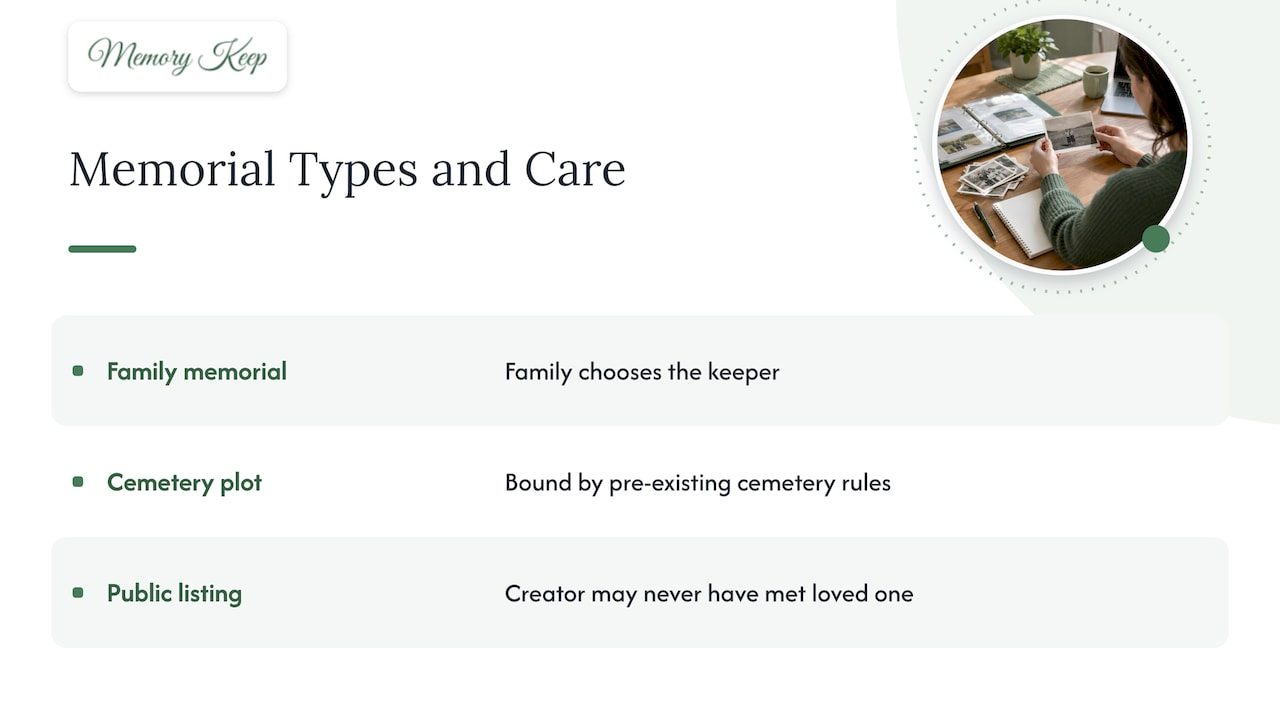
That is also why we encourage families to start with something small. One photo and a caption is a perfectly good beginning, and a page can grow as people contribute. If you are not ready for a full memorial, a living memorial such as a garden or a tree can sit alongside it.
What We Believe About Keeping a Memorial
Over the years the biggest worry we hear about memorials is not technology. It is the fear that a loved one’s story will end up in the wrong hands, or in no one’s.
We built Memory Keep around the opposite idea. A memorial should belong to the people who loved the person, stay available for years, and never come with a bill that returns every year. That is why the upgrade is a single payment for each memorial, with no subscription and no renewal. We do not run ads and we do not sell data.
We also think a memorial works best when it is shared. Family members can add photos and videos, friends can leave messages, and every memorial has a unique link and a free QR code that can go on a program, a card or a headstone. When many people hold a piece of the memory, no one person has to carry it all.
Our advice is simple: choose a keeper, name a second person, and tell the family where the details are kept. Do it while you are together.
Memory Keep
Start a Memorial You Can Share and Hand On
Memory Keep offers a Free plan and a Full plan. The Full plan is a $15 one-time payment per memorial, with no subscription, and it unlocks unlimited photos, videos and features. Each memorial has its own shareable link and a free scannable QR code, and you can create keepsake photo books and slideshow videos from it.
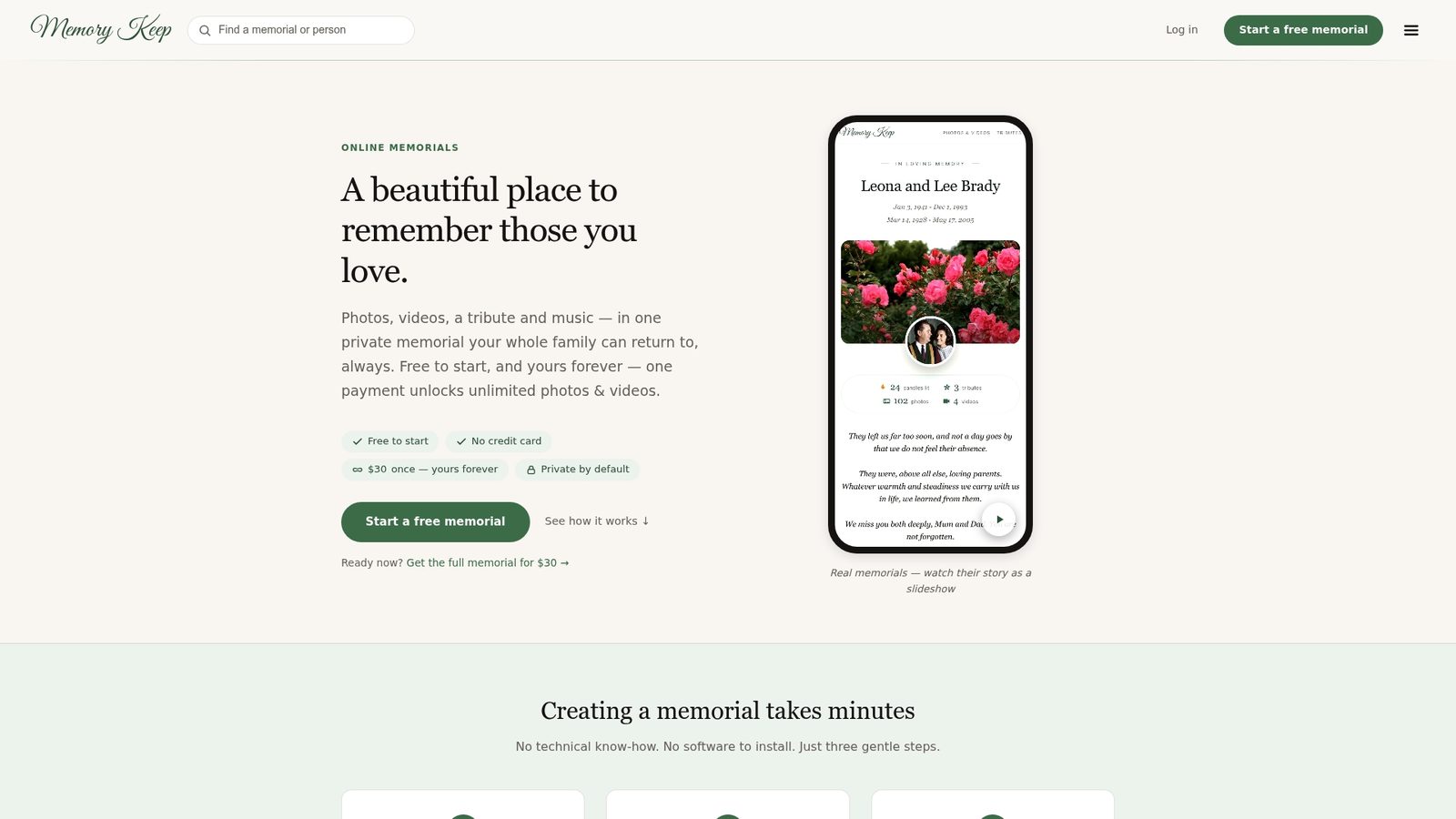
You can begin with the Free plan, add the first photo tonight, and invite your family to add theirs. When you are ready to keep everything together, you can see the plans on our pricing page.
A Short Checklist for Any Kind of Handover
Whatever kind of memorial you are dealing with, these steps keep things calm:
- Name who holds it today and how they can be reached.
- Write down who is next and tell them.
- Gather the proof that may be asked of you: relationship, dates, original paperwork.
- Ask in writing, politely, and keep a copy.
- Save the photos and stories somewhere safe in case a page changes hands.
- Tell the family when the handover is done, so everyone knows where to go.
FAQ
Can I transfer a cemetery plot to a family member?
Usually yes, but only through the cemetery. Published cemetery rules, such as those at Cypress Lawn, say a transfer counts only when the cemetery approves it and records it. Call the office first and ask for its form and fees.
Do I own the land under a grave?
In most cases you do not. Cemetery rules like Oakwood’s in Wisconsin describe the purchase as an easement, meaning the right of interment. The cemetery keeps control of the ground.
Who should keep a family’s online memorial?
Choose the person who is willing and able to look after it, and name a second person as backup. Others can still add photos, videos and messages without holding the keys.
What if I need to change who looks after my Memory Keep memorial?
Visit our help page and tell us which memorial it is and what has changed. We will guide you from there.
Sources
- Cypress Lawn Memorial Park rules and regulations
- Pine Lawn rules and regulations
- Town of Ipswich cemetery rules and regulations
- Oakwood Cemetery rules, regulations and fees
- Pierce Law: cemetery lot transfer documents in North Carolina
- Canvas vs acrylic prints for memorial photos